

Football is one sport that requires more from your body compared to any other sport. More than 1000 direction changes, repeated sprint ability, aerial challenges and involved sustained high intensity effort can occur during a standard 90 minute match. A 2020 research paper published in the Journal of Sports Sciences found that elite outfield players run anywhere from 10 to 13 kilometres per game and a high percentage of this is high-intensity running.
There is no point in doing everything without a plan, since you tend to over-train the wrong things or miss out on the important things. The weekly football fitness training plan is a combination of strength, speed, endurance and recovery in the correct sequence and quantity. You’ll get a precise daily timetable, details of each session and what to expect from it, as well as a realistic time estimate for results.
| Disclaimer
The information contained in the exercises or suggestions for training is provided for general purposes. Take time to properly warm up before exercise. If a person has previous injuries or a medical condition, please seek advice from a qualified Physiotherapist or Sports doctor before undertaking any new training programme. VanoraHub is unable to accept accountability for any type of injuries incurred when using this guide. |
| Quick Answer
A fitness training routine for football players should be 5-6 days a week of fitness sessions, a range of speed and agility training, strength training in the gym, football specific conditioning and 1 full day of rest. Building explosive power, aerobic capacity and repeat sprint ability, every 90 min is its main purpose. |
Weekly Football Fitness Schedule: At a Glance

| Day | Training Focus | Time Needed |
| Monday | Active recovery/mobility | 20-30 min |
| Tuesday | Speed and agility | 45-60 min |
| Wednesday | Strength training (gym) | 50-60 min |
| Thursday | Football-specific conditioning | 60-90 min |
| Friday | Power and gym session | 50-60 min |
| Saturday | Match or match simulation | 90 min |
| Sunday | Full rest | — |
Why Footballers Need a Structured Training Plan
Random training produces random results. The majority of amateur players are either running too much doing too little in the gym or they are training hard with little recovery built in. Each of these habits creates some disturbances and eventually injuries.
A particularly high risk factor for hamstring injuries in football is strength imbalance between the quadriceps and hamstrings, identified in a study published in the British Journal of Sports Medicine (2018). This is tackled by a structured strength conditioning programme. If done regularly, even five or six workouts per week can lead to measurable fitness improvements within 6-8 weeks.
Speed and Agility Training
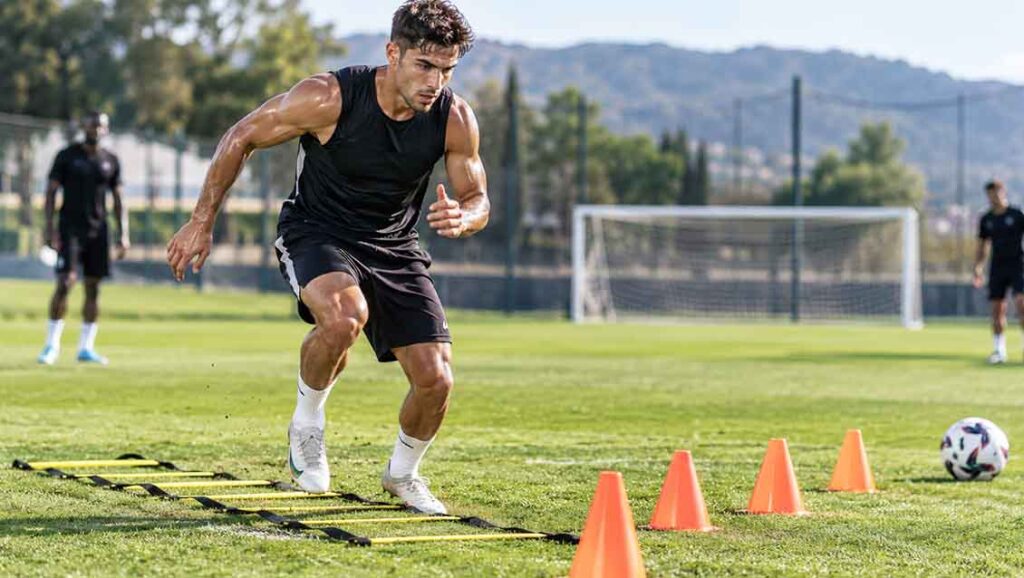
Speed and agility work is most effective early in the week, after adequate rest, not after fatigue has already set in. For footballers, this means short sprint repeats and direction-change drills rather than long jogs.
What to include:
- 10m to 30m sprint repeats: 6 to 8 reps, full recovery between each
- Ladder drills: foot speed and coordination
- 5-10-5 shuttle runs: change-of-direction ability under time pressure
- Reactive agility drills: responding to a partner or visual cue, which mirrors real match decisions
Make speed sessions no longer than 60 minutes. If your sprint times are clearly becoming poorer in the 2nd half of a session then STOP. Quality is the focus here, and not volume.
Strengthening Core Skills for Football Players.

Strength training makes you harder to take the ball away from and makes you move much quicker in one-on-one situations and much less likely to injure yourself. It is in no way bodybuilding.
Key exercises for footballers:
- Back squat or goblet squat: lower-body power
- Romanian deadlift: hamstring strength, a direct injury-prevention tool
- Bulgarian split squat: targets strength imbalances between legs
- Hip thrusts: glute strength, directly linked to sprinting speed
- Pull-ups and dumbbell rows: upper-body strength for aerial duels and physical challenges
Try to perform 3-4 sets of 4-8 reps with compound movements. Data from a study in the Scandinavian Journal of Medicine and Science in Sports in 2022 showed that progressive overload is key for players’ strength to progress in football. If you continue to perform the same amount of reps and the same amount of weight per week, you won’t make any further adaptations.
Football-Specific Conditioning
Football Conditioning is training of energy systems used in the sport. Long slow runs at low intensity will not adequately allow you to make repeated higher runs. Small-sided games, interval running and possession based drills are a lot more match relevant.
Conditioning methods worth using:
- Small-sided games (SSGs): 3v3 or 4v4 on a tight pitch gives natural high-intensity conditioning with the ball
- High-intensity intervals: 30 seconds at maximum effort, 30 seconds rest, 10 to 15 rounds
- Aerobic threshold runs: 20 to 30 minutes at 65 to 75% of maximum heart rate, building your aerobic base
Researcher Jens Bangsbo, who developed the Yo-Yo Intermittent Recovery Test (widely adopted by UEFA and FIFA for fitness assessment), demonstrated that football-specific conditioning consistently outperforms generic cardio for improving match performance outcomes.
Sample Weekly Fitness Plan for Football Players
This plan assumes Saturday is your match day. Adjust based on your actual fixture schedule.
Monday: Active Recovery
Light walking, foam rolling, 20 minutes of dynamic stretching. Focus on the hips, hamstrings, and calves. Heart rate stays low.
Tuesday: Speed and Agility
10-minute warm-up, then sprint intervals and agility drills for 35 to 40 minutes, followed by a 10-minute cool-down.
Wednesday: Strength Training
Squat, Romanian deadlift, Bulgarian split squat, hip thrust, pull-ups. 3 to 4 sets each. Take 90 to 120 seconds to rest between sets.
Thursday: Football-Specific Conditioning
If training with your team, prioritise small-sided games and possession work. If training alone, run 10 x 150m intervals at 85 to 90% effort with 45-second rest periods.
Friday: Power Session

Medicine ball throws: lighter strength exercises with greater velocity. Lighter strength with greater velocity: explosive work.Explosive work: box jumps, medicine ball throws. 45 to 50 minutes total.
Saturday: Match or Match Simulation
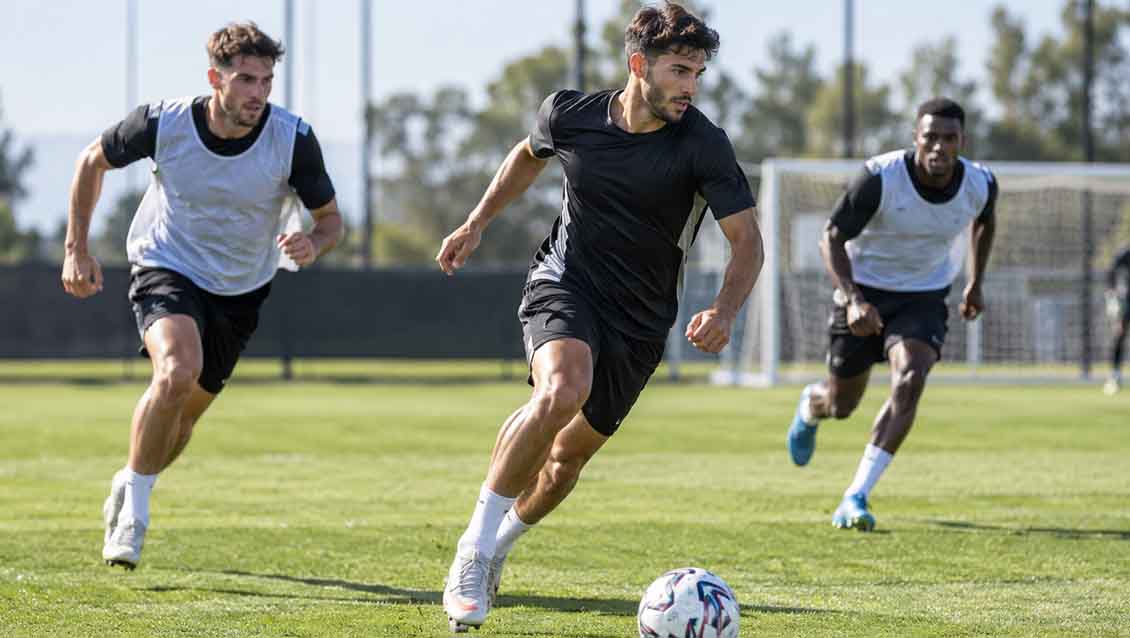
Full match or a high-intensity session replicating match conditions.
Sunday: Full Rest
No training. Emphasis on sleep, hydration and food
How Long Before You See Results
Expect a realistic timeline, not a dramatic one.
- 2 to 3 weeks: Better energy levels, faster recovery between sessions
- 4 to 6 weeks: Noticeable speed and strength improvements
- 8 to 12 weeks: Real match-fitness gains, less fatigue in the final 20 minutes
Sports science research consistently shows that VO2 max improvements in football players require at least 8 to 10 weeks of structured conditioning. Consistency over time is what drives change. One hard week does not compensate for three inconsistent ones.
Common Mistakes to Avoid
- Skipping rest days. Recovery is where physical adaptation happens. Training every day without adequate rest leads to overtraining, not improvement.
- Too much long-distance running. Footballers are explosive athletes. Excessive low-intensity distance running can reduce fast-twitch muscle fibre recruitment over time.
- Ignoring single-leg exercises. Most leg imbalances go undetected until an injury occurs. Include Bulgarian split squats and single-leg deadlifts in every strength block.
- Training hard the day before a match. A light technical session or full rest is the right call within 24 hours of a game.
- No progressive overload in the gym. If you lift the same weights for the same reps every week, your body stops adapting. Increase resistance, volume, or both every two to three weeks.
FAQ
How many days a week should a footballer train?
Five to six days per week is appropriate for most football players, with one full rest day and one active recovery day built in. Raw training volume matters less than session quality and consistent structure.
Should footballers do weight training?
Yes, weight training reduces injury risk and builds the explosive strength the game demands. Focus on compound lifts and single-leg movements rather than machine-based isolation work.
How can I improve my football fitness in a short time?
Combine high-intensity intervals with small-sided games. A 2020 review in the Journal of Human Kinetics found small-sided game training produced significant aerobic and anaerobic improvements in football players within six to eight weeks.
Is running or the gym more important for football fitness?
Neither in isolation gets the job done. Football fitness requires both aerobic conditioning and muscular strength. A plan built around only one of these leaves clear gaps in your physical readiness.
What should I eat before and after training?
Carbohydrates before training fuel your sessions, and protein afterward supports muscle recovery. The British Dietetic Association recommends 1.4 to 2.0g of protein per kilogram of body weight daily for athletes. For personalised guidance, consult a registered sports nutritionist.
Conclusion
It isn’t difficult to become fit for football, but it does take work. It’s not about sprinting one day per week, lifting heavy two days per week, and conditioning the remainder of the time, it’s about balancing speed, strength, conditioning and rest throughout the week with a proper weekly fitness plan. With 8-12 weeks of diligence, you will see the rewards in the last 20 minutes of the game when everyone else is turning their backs on you. Begin the plan, continue it and tweak it if your body is feeling it.
Choose suitable movements from our football fitness exercise guide rather than adding every exercise to every session. Use the attendance tracker to record planned team sessions and review consistency; it should support the schedule, not replace decisions about recovery.
Looking to measure your sprint times and acceleration intervals during Speed & Agility sessions? Calculate your velocity in km/h, mph, and m/s with the Football Sprint Speed Calculator.

1 comment on “Football Fitness Plan: 7-Day Weekly Guide for Players”