
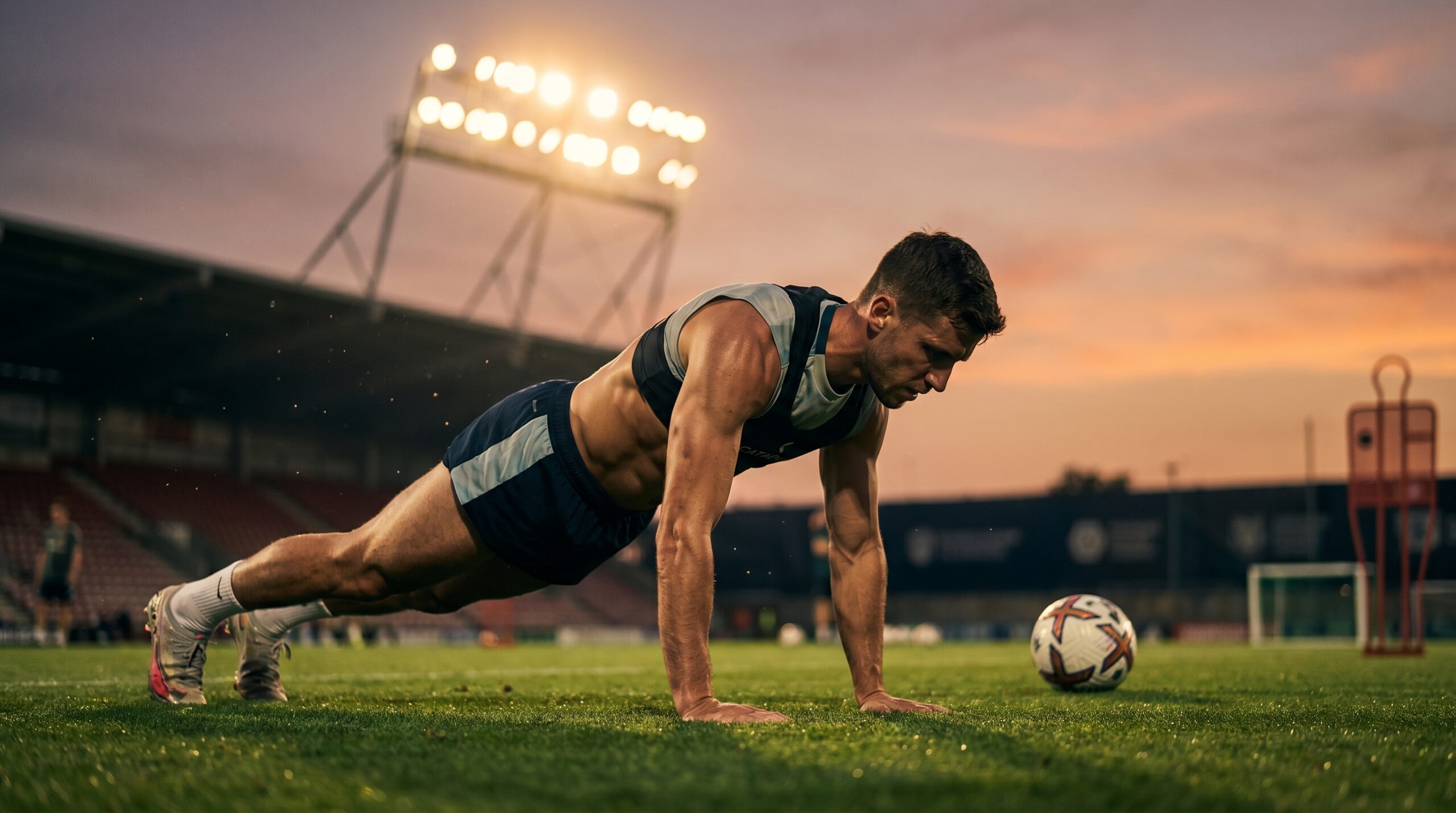
Trunk strength and control play a role in football movements, alongside leg strength, coordination and technique. Training the muscles around your trunk and hips can support control during these movements.
Sit-ups train one aspect of trunk movement. A varied programme can also include exercises that resist extension, rotation and lateral bending.
In this guide, we break down the best core exercises for football players with practical instructions and example training volumes. You’ll learn the most effective exercises, proper sets and reps, and a complete football core workout routine you can actually follow. We’ll also answer the most common questions players ask about core training and performance.
In This Article
- Why Core Strength Matters for Football
- The Best Core Exercises for Football Players
- A Complete Football Core Workout Routine
- Balance and Stability Exercises for Football
- Home Core Workout for Football Players
- Common Mistakes to Avoid
- Frequently Asked Questions
Why Core Strength Matters for Football

Your core is more than just abs. It has the deep stabilizers, like the transverse abdominis, your lower back, hips, glutes and obliques. These muscles govern your posture, transfer force from your upper to your lower body, and help control your trunk during movement.
On the pitch, trunk control helps connect movements of the upper and lower body. It works alongside leg strength, balance, coordination and football technique; no single muscle group determines performance or injury risk.
Training context
FIFA’s athleticism resources include core work as one part of youth development. The exercises below are options to adapt to age, experience, total workload, match schedule and injury history.
The Best Core Exercises for Football Players
These seven exercises address several demands on your midsection: anti-extension, anti-rotation, lateral stability, and explosive power. Choose a manageable selection rather than treating all seven as compulsory.
1. Dead Bug
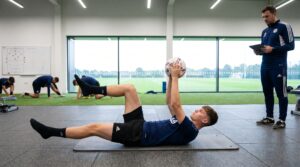
The dead bug is one of the most effective core exercises a footballer can do. Lie on your back, arms pointing to the ceiling, knees at 90 degrees. Slowly lower one arm and the opposite leg toward the floor without letting your lower back arch. Return and repeat on the other side. The keyword is slowly. This exercise trains your deep stabilisers to resist extension, a quality relevant to controlling your trunk during football movements.
2. Plank Variations
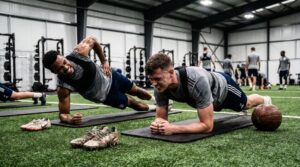
A standard plank builds basic anti-extension strength. Progress when you can maintain good alignment and breathe normally for the chosen duration. The RKC plank (squeeze everything, create maximum tension) is far harder than it looks. Side planks target your lateral chain, which is critical for resisting being pushed off the ball.
3. Pallof Press
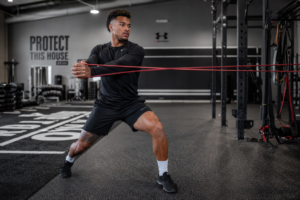
Attach a resistance band to a fixed point at chest height. Stand sideways to it, hold the band at your chest, then press it straight out in front of you and hold for 2 seconds before returning. Your core works to resist the rotational pull. This trains resistance to rotation, which can support body control during football actions.
4. Copenhagen Plank
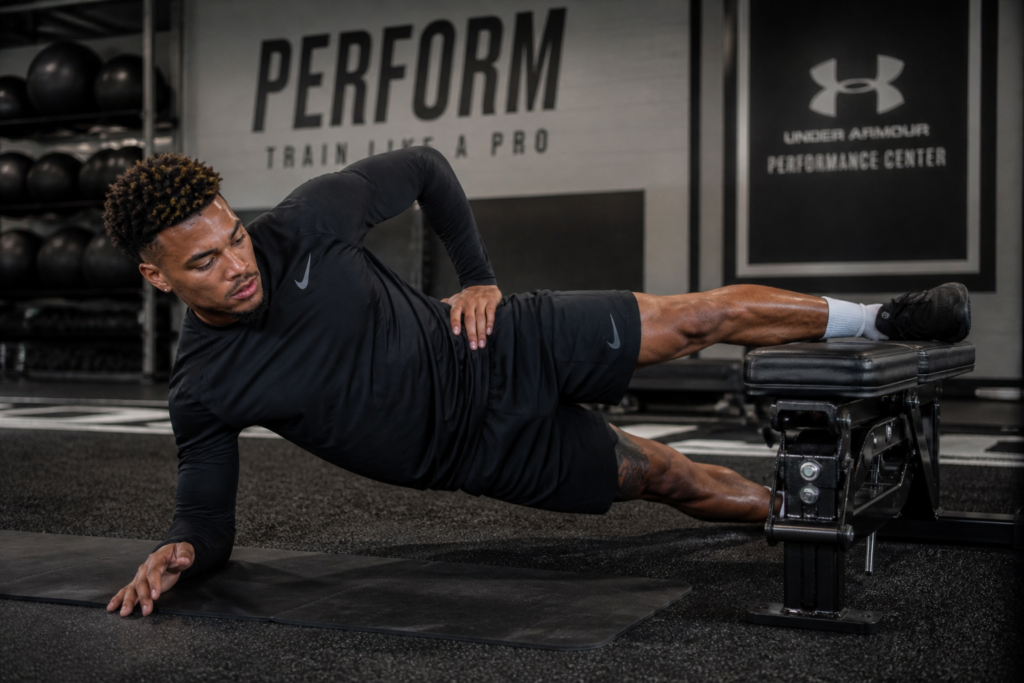
Support your upper body on your forearm and place your top knee on a stable bench for a shorter-lever Copenhagen plank. Keep the pelvis controlled. The bottom leg can help support you at first; a top-foot version is a harder progression.
This exercise loads the inner-thigh muscles and lateral trunk. Begin conservatively with suitable coaching, especially after a groin injury. It does not guarantee injury prevention, and the example holds below are not a starting requirement for everyone.
5. Russian Twist
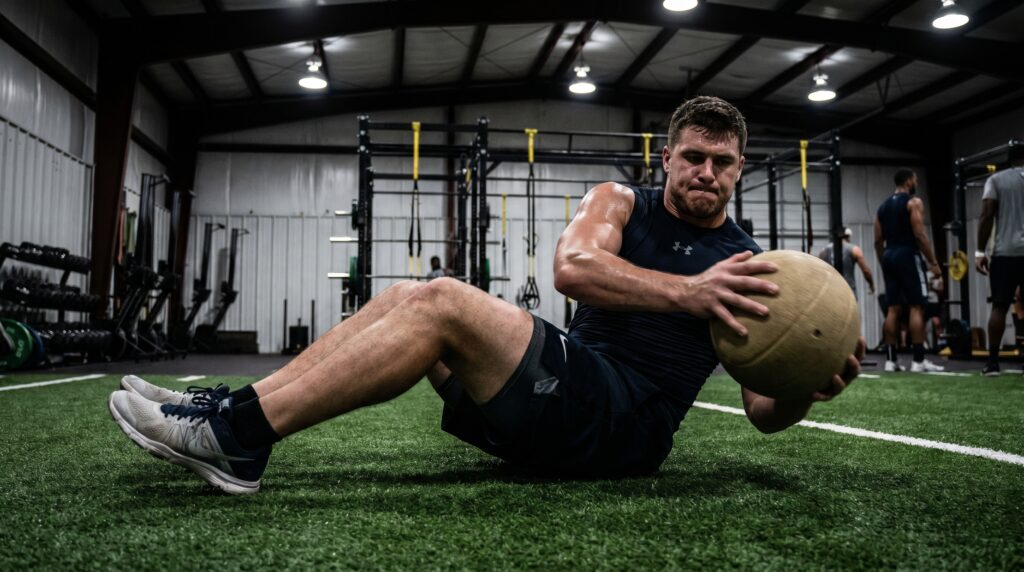
Sit with knees bent and feet supported. Use a small, controlled rotation without forcing your back. Begin without added weight. The rotation trains your obliques under load, but it does not guarantee a harder shot or faster turn. Add only a light load you can control, and choose another exercise if it causes back discomfort.
6. Hanging Leg Raise
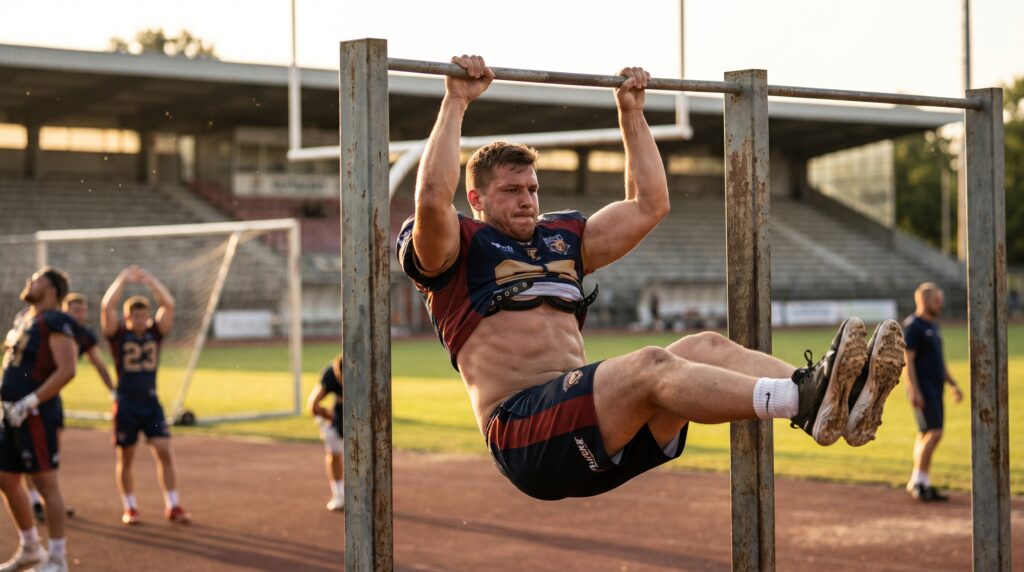
Hang from a pull-up bar and raise your legs until they are parallel to the floor. Control the descent. This builds serious hip flexor and lower abdominal strength. Keep the movement controlled and avoid swinging. Start with bent knees if straight-leg raises are too hard.
7. Suitcase Carry (Single-Arm Farmer Carry)
Pick up a manageable kettlebell or dumbbell in one hand and walk 20 to 30 metres in a straight line. Your core has to resist the lateral lean caused by the unilateral load. This trains the kind of stability you need when carrying the ball at speed or holding off a challenge with one arm extended.
| Exercise | Sets x Reps | Rest | What It Trains |
| Dead Bug | 3 x 8 each side | 45 sec | Deep stabilisers, anti-extension, lower back control |
| Copenhagen Plank | 3 x 25 sec each side | 45 sec | Lateral core and adductors |
| Pallof Press | 3 x 10 each side | 45 sec | Anti-rotation strength. Ball shielding, body positioning |
| Russian Twist | 3 x 12 each side | 45 sec | Oblique strength and controlled rotation |
| Hanging Leg Raise | 3 x 10-12 | 60 sec | Abdominal control and hip flexors |
| Side Plank | 3 x 35 sec each side | 30 sec | Lateral stability. Resisting pressure in 1v1 situations |
| Suitcase Carry | 3 x 25 m walk | 60 sec | Full lateral chain, grip, and postural endurance |
A Complete Football Core Workout Routine
The table is an example menu for a player already familiar with these exercises. Start with a few suitable movements and fewer sets if needed. Do not add every table in this article together as one workout. Rest long enough to maintain control; total time depends on the exercises and volume chosen.
| Exercise | Sets | Reps / Duration |
Rest |
|
Dead Bug |
3 | 8 each side |
45 sec |
|
Copenhagen Plank |
3 | 25 sec each side |
45 sec |
|
Pallof Press |
3 | 10 each side | 45 sec |
| Russian Twist (loaded) | 3 | 12 each side |
45 sec |
| Hanging Leg Raise | 3 | 10 |
60 sec |
| Side Plank | 3 | 35 sec each side |
30 sec |
Fit core work into the overall strength plan with recovery between demanding sessions. Reduce or omit it around heavy training, matches, soreness or injury rehabilitation. A qualified coach can set an appropriate frequency.
Balance and Stability Exercises for Football
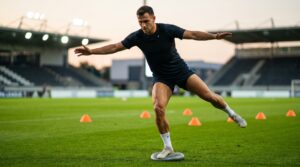
Balance and core strength are two sides of the same coin. You can have strong abs and still wobble when a defender leans into you, because balance is also a neuromuscular skill. These exercises train your body to stabilise quickly and automatically.
Single-Leg Romanian Deadlift
Stand on one leg, hold a light dumbbell, and hinge at the hip only as far as you can maintain balance and a controlled back position. Return slowly. This trains the hamstrings, glutes, and stabilisers simultaneously. It also mirrors the moment just before you plant and kick, when you’re balanced on one leg at high speed.
Bulgarian Split Squat
Back foot elevated on a bench, front foot forward. Lower through a comfortable range with control. This develops single-leg strength and balance; it is not a promise of fewer ankle or knee injuries.
Reactive Balance Drills
Stand on one leg and have a partner toss a ball at random angles for you to catch and return. The unpredictability forces your nervous system to respond fast. You can replicate this alone by standing on one leg and tossing a ball against a wall at different spots. For example, try short sets and stop before balance or technique deteriorates.
Home Core Workout for Football Players
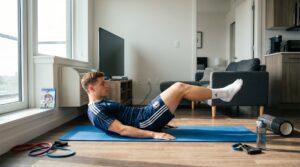
Several core exercises can be adapted for home training. Most of the best core exercises for football players need nothing but floor space and 15 minutes.
Here is an example bodyweight home circuit to adapt to your level:
- Hollow Body Hold– 3 sets x 30 seconds. Lie on your back, press your lower back into the floor, and lift your arms and legs a few inches off the ground. Hold without letting your back arch.
- Dead Bug– 3 sets x 8 each side. Described in full above.
- Side Plank– 3 sets x 35 seconds each side.
- Mountain Climbers– 3 sets x 20 seconds. Bring each knee forward with control while keeping your hips flat. Use a pace that allows you to keep the trunk steady.
- Glute Bridge– 3 sets x 15 reps. Lift your hips until your shoulders, hips and knees form a line, pause at the top, and lower slowly. Progress to single-leg when this becomes easy.
Tip for Home Training
Use this circuit as an alternative to the gym-based menu, not an extra session on top of it. Choose a suitable frequency within your overall schedule, allow recovery, and prioritise controlled movement over short rests. An optional resistance band adds load but is not necessary.
For help organising technical work around strength training, see the home football training plan.
Common Mistakes Footballers Make With Core Training
Relying on sit-ups and crunches. These exercises train spinal flexion, which is a relatively small part of what football demands. Your core needs to resist movement, not just create it. Shift to anti-extension and anti-rotation exercises.
Core isolation training. Core exercises are most important when your whole body is involved. Squats, deadlifts and lunges all require your core to fire up. If you’re missing compound lifts, you’re missing a lot of core stimulus.
Rushing through reps. Speed kills the purpose of most core exercises. Use a pace that lets you maintain control and the intended range of motion.
Skipping unilateral work. Football is a one-sided sport. You plant on one leg, kick with the other. Copenhagen planks, single-leg RDLs, and single-arm carries train the asymmetries that matter on the pitch.
No progressive overload. Core training follows the same principles as any other training. If the chosen plank variation becomes easy with consistent form, consider a small progression. Add weight, reduce the base of support, or increase time under tension. Change one variable at a time.
Frequently Asked Questions
What are the best core exercises for football players?
The best core exercises for football players are dead bugs, Copenhagen planks, pallof press, Russian twists, hanging leg raises, side planks, and suitcase carries. These address several trunk-training demands: anti-extension, anti-rotation, lateral stability, and rotational power.
How often should a footballer train their core?
There is no universal frequency. Fit core work into your strength programme according to age, experience, training load, matches, recovery and injury history. Short sessions may be practical, but demanding work still needs recovery.
Can I do a football core workout at home?
Yes. Dead bugs, hollow holds, side planks, mountain climbers, and glute bridges all require nothing but floor space. A resistance band adds variety but is not essential. This circuit complements technical, lower-body strength and conditioning work; it does not replace a complete programme.
Will core training make me a better footballer?
Core work can support trunk control and strength, but improved football performance also depends on technical practice, tactical learning, overall conditioning and recovery. No core routine guarantees faster movement, stronger shots or freedom from injury.
How long before I see results from core training?
Progress varies with the starting point, exercise selection, consistency and recovery. Track technique and manageable increases in difficulty rather than expecting a fixed result within a particular number of weeks.
Conclusion
Choose core exercises that you can perform with control and fit them into your wider football schedule. Dead bugs, side planks and suitably loaded carries provide practical starting options, with harder variations added gradually.
These instructions are general educational guidance. Stop exercises that cause pain and seek a qualified coach or physiotherapist’s advice for injury-specific issues.
For movements beyond trunk training, explore these football fitness exercises. Our weekly fitness schedule shows how strength work can sit alongside technical practice and recovery, rather than treating every day as another demanding workout.

3 comments on “Best Core Exercises for Football Players for Strength & Balance”