

The non-negotiable daily football workout that builds elite-level speed, strength, and stamina — no matter your age or level.

In This Article
- Introduction: Why Daily Football Fitness Exercises Change Everything
- Quick-Reference: All 7 Exercises at a Glance
- Exercise 1 — Jump Squats
- Exercise 2 — Nordic Hamstring Curl
- Exercise 3 — Lateral Cone Shuffle
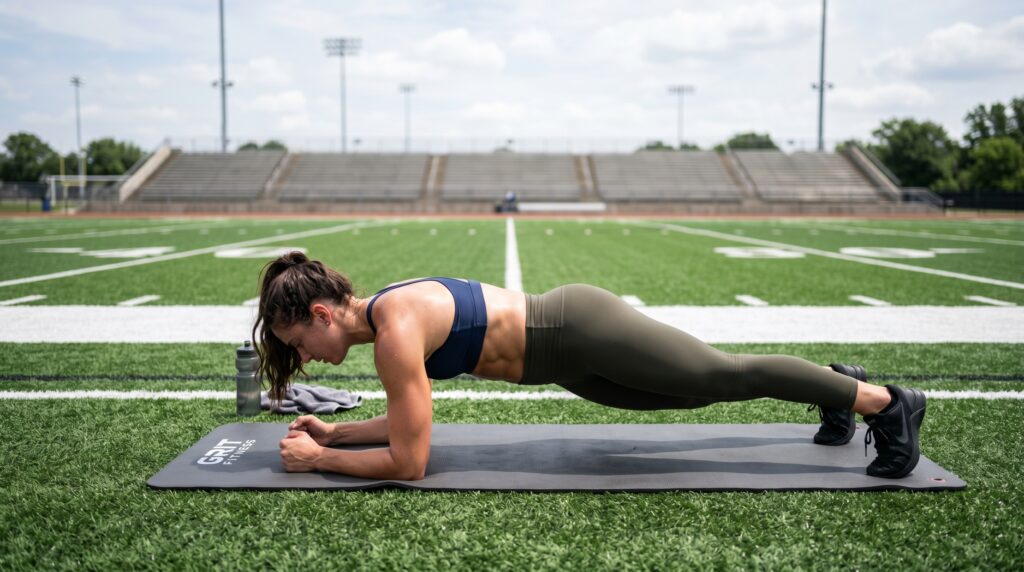
- Exercise 4 — Plank with Hip Dip
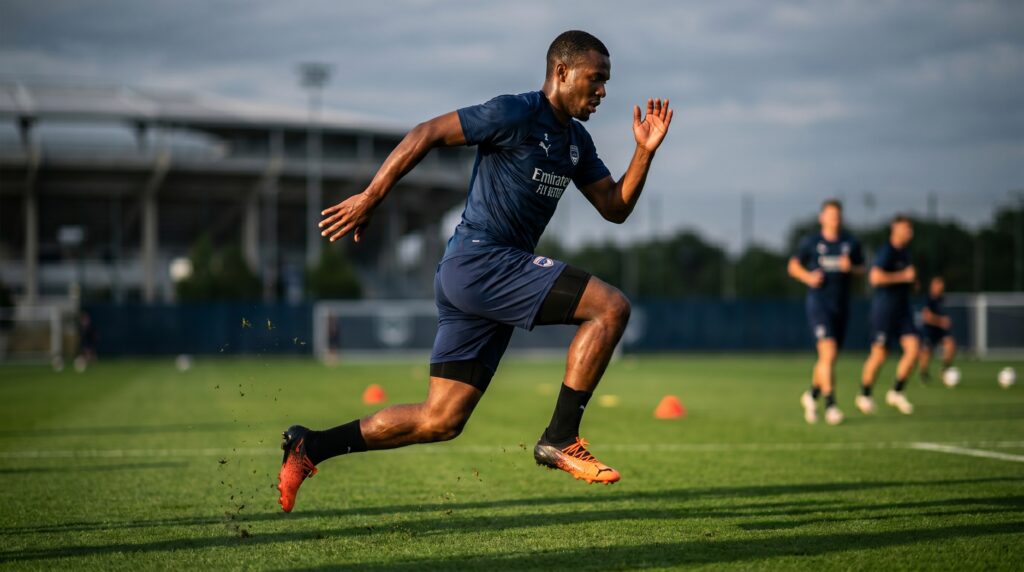
- Exercise 5 — Plyometric Lunges
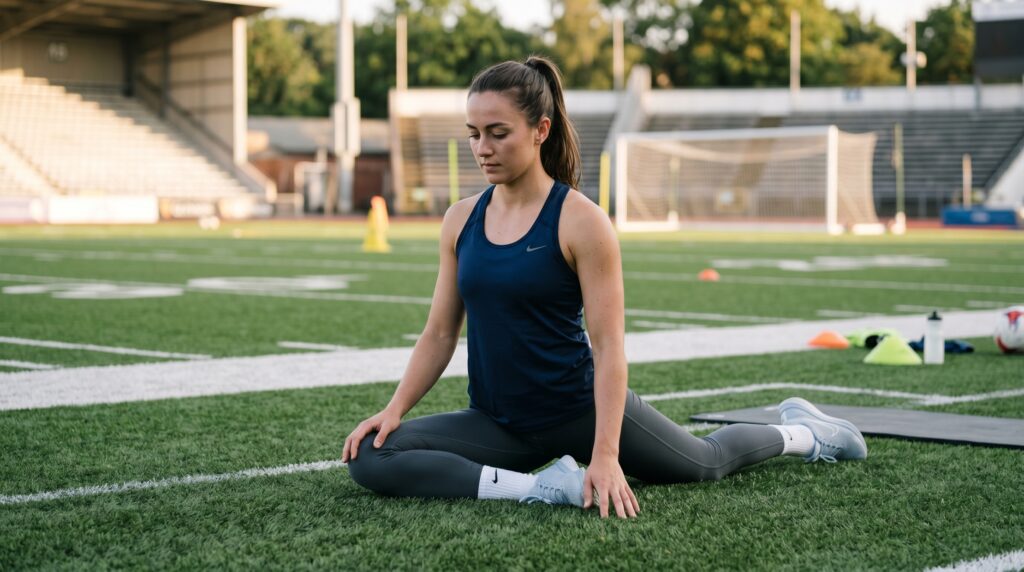
- Exercise 6 — 90/90 Hip Stretch
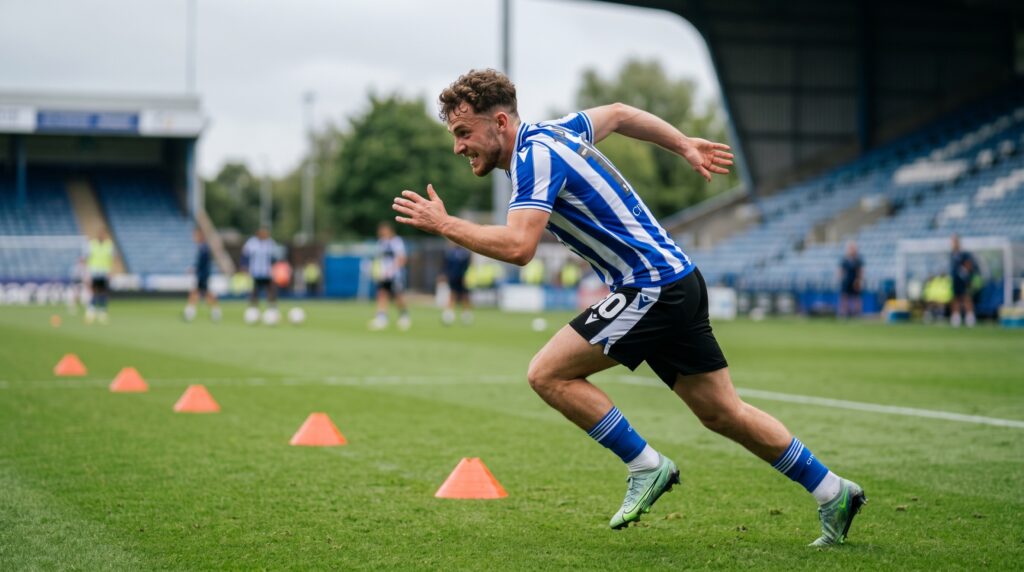
- Exercise 7 — Sprint Intervals (30m)
- How to Fit These Into Your Daily Routine
- FAQ
- Conclusion & CTA
Why Daily Football Fitness Exercises Change Everything
Ask any professional coach what separates good players from great ones, and very few will mention talent first. They’ll talk about habits. Specifically, the small, disciplined things players do every single day before team training, after a match, even on rest days.
Football fitness exercises done consistently will always be better than going to the gym once a week and working out hard. The body gets used to things that happen over and over again. That’s the science behind why the 7 movements in this guide are chosen for daily use they’re efficient, joint-friendly enough to repeat, and directly transferable to what happens on the pitch.
According to a 2023 study in the Journal of Sports Sciences, players who followed a structured daily conditioning programme improved their sprint speed by 8.4% and reduced soft-tissue injuries by nearly 30% over a 12-week period. The exercises below are rooted in exactly that kind of evidence.
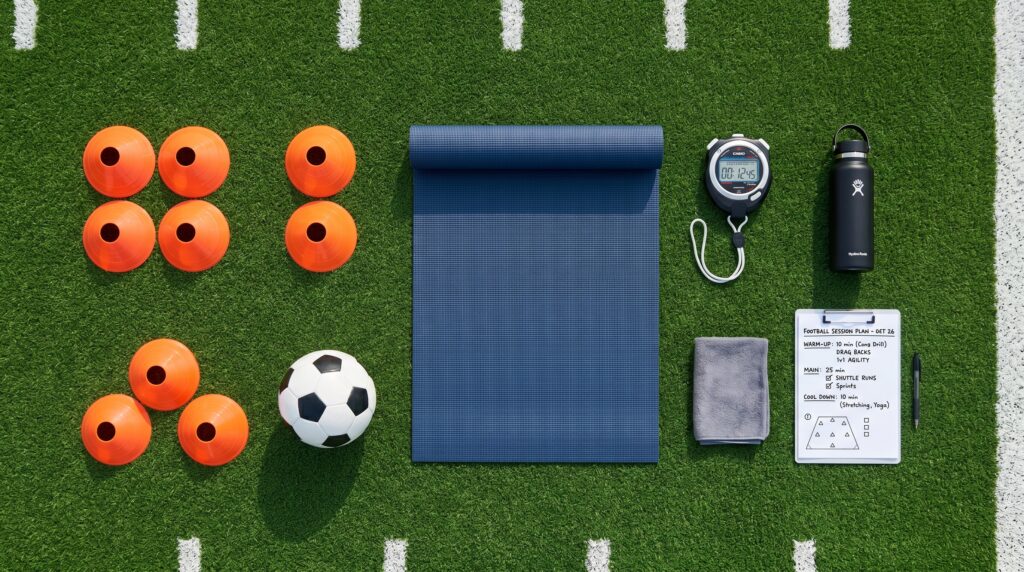
What You’ll Get From This Daily Routine
- Fast acceleration and top speed.
- Hamstring and hip resilience — the most common injury sites in football
- Being able to change direction quicker than your opponent
- A core that is as powerful as a rock and keeps you upright at high speeds
- Flexibility that prevents niggles and keeps you on the pitch longer
Quick-Reference: All 7 Exercises at a Glance
Before we break each one down, here’s your at-a-glance cheat sheet. Bookmark this table — it’s your daily checklist.
| # | Exercise | Sets × Reps | Primary Benefit |
| 1 | Jump Squats | 3 × 15 | Explosive leg power & sprint acceleration |
| 2 | Nordic Hamstring Curl | 3 × 6 | Hamstring strength & injury prevention |
| 3 | Lateral Cone Shuffle | 4 × 30s | Agility, lateral speed & coordination |
| 4 | Plank with Hip Dip | 3 × 45s | Core stability & rotational control |
| 5 | Plyometric Lunges | 3 × 10 each leg | Quad power, balance & single-leg strength |
| 6 | 90/90 Hip Stretch | 2 × 60s each side | Hip mobility & injury prevention |
| 7 | Sprint Intervals (30m) | 6–8 × 30m | Speed, VO2 max & anaerobic conditioning |
Total daily time commitment: approximately 20–25 minutes. That’s it. Let’s break each one down properly.
Exercise 1 Jump Squats
|
Sets × Reps |
3 sets × 15 reps |
| Rest |
45 seconds between sets |
|
Equipment |
None — bodyweight only |
|
Primary Muscles |
Quadriceps, glutes, calves, core |
|
Football Benefit |
Sprint acceleration, jumping for headers, explosive first step |
|
Progression |
Add a resistance band above knees or hold a light dumbbell |
How to Do It Correctly
- Stand with your feet shoulder-width apart and your toes pointing slightly out.
- Lower yourself into a squat until your thighs are parallel to the ground. Keep your chest up.
- Push through your heels with all your strength, fully extending your hips and knees.
- Leave the ground with both feet, arms driving upward.
- Land softly on the balls of your feet and then go right into the next squat
- That’s one rep. No pausing at the bottom.
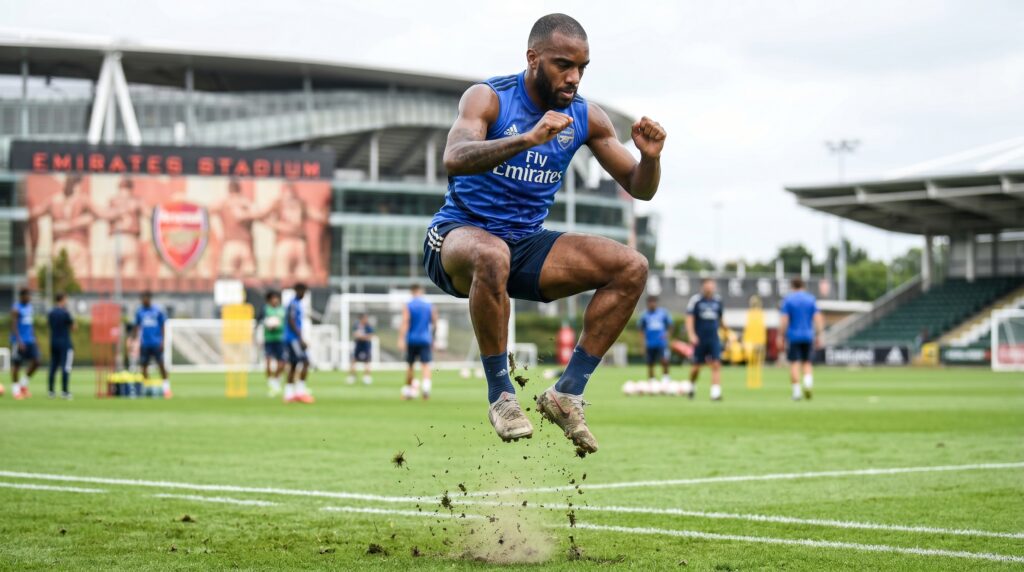
Why it works for football: Jump squats train the stretch-shortening cycle — the same explosive mechanism your legs use when you burst away from a defender or leap for a cross. Players who perform this movement daily develop measurably faster acceleration within 3–4 weeks.
Exercise 2 Nordic Hamstring Curl
|
Sets × Reps |
3 sets × 6 reps (quality over quantity) |
|
Rest |
90 seconds — this is demanding |
| Equipment |
Partner to hold feet, or anchor under a sofa/bar |
|
Primary Muscles |
Hamstrings (eccentric emphasis), glutes |
| Football Benefit |
Reduces hamstring strain risk by up to 51% (BJSM research) |
|
Progression |
Add a resistance band for assistance; progress to unassisted over weeks |
How to Do It Correctly
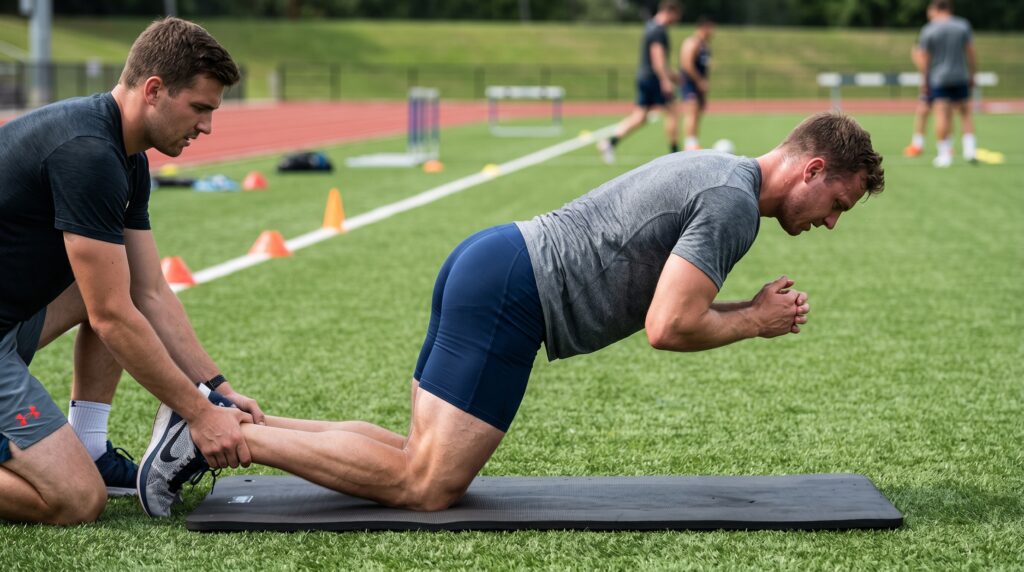
- Kneel on a soft surface. Have a partner hold your ankles, or secure them under something stable.
- Keeping your body straight from knee to shoulder, slowly lower your torso toward the floor.
- Control the descent as long as possible — aim for 3–4 seconds down.
- Use your hands to catch yourself at the bottom, then push back up.
- Squeeze your hamstrings forcefully to pull yourself back to the start position.
- That eccentric (lowering) phase is where all the adaptation happens — never rush it.
Why it’s essential: Hamstring injuries are the most common muscle injury in football, accounting for around 17% of all time-loss injuries. The Nordic curl directly targets the weakest point of the hamstring — its eccentric strength — which is precisely what gets torn during maximum-speed sprinting.
Exercise 3 Lateral Cone Shuffle
|
Sets × Duration |
4 sets × 30 seconds, maximal effort |
|
Rest |
30 seconds between sets |
|
Equipment |
4–6 cones or any ground markers |
|
Primary Muscles |
Glutes, hip abductors, calves, fast-twitch fibres |
|
Football Benefit |
Defensive positioning, tracking runners, beat press traps |
|
Progression |
Add a reactive element — partner calls direction as you shuffle |
How to Do It Correctly
- Set up 4–6 cones in a straight line, 1 metre apart.
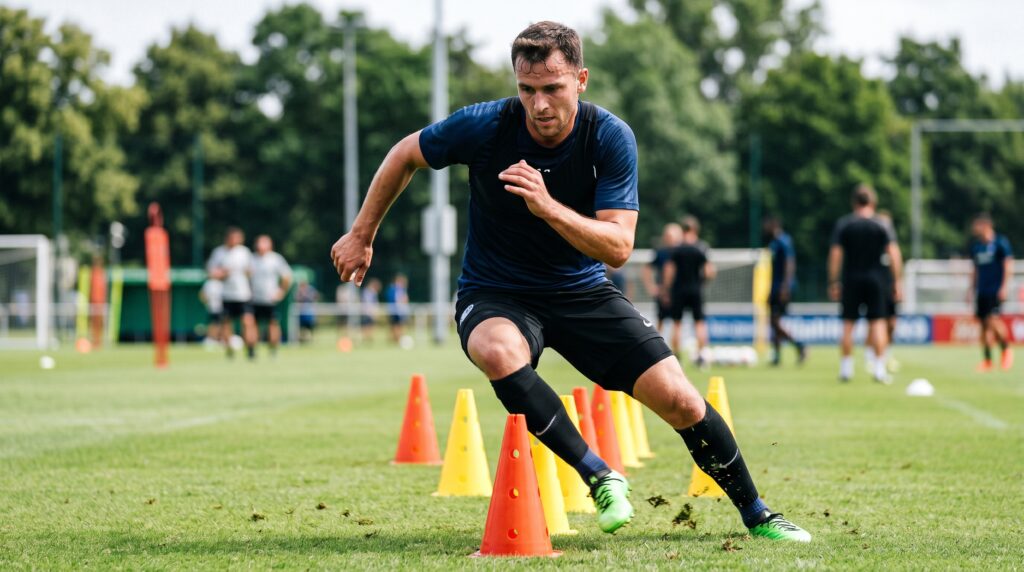
- Start in an athletic stance — knees bent, weight on balls of feet, hips low.
- Shuffle laterally, touching each cone with the nearest hand before changing direction.
- Stay low throughout. The moment your hips rise, you lose power and speed.
- Drive off the outside foot to reverse direction — don’t cross your feet.
- Keep your head up and eyes forward, as you would when tracking an attacker.
Football application: Studies show footballers make between 700–1,200 direction changes per match. Your ability to decelerate and accelerate laterally is one of the most game-decisive physical qualities you can train — and it’s almost entirely neglected by players who only run in straight lines.
Exercise 4 Plank with Hip Dip
|
Sets × Duration |
3 sets × 45 seconds |
|
Rest |
30 seconds between sets |
|
Equipment |
Yoga mat or firm surface |
|
Primary Muscles |
Transverse abdominis, obliques, lower back, shoulders |
|
Football Benefit |
Body balance in aerial duels, shielding ability, shooting power |
|
Progression |
Extend to 60 seconds; add a resistance band around knees for hip activation |
How to Do It Correctly
- Get into a forearm plank: elbows under shoulders, body in a straight line from heel to head.
- Engage your core — imagine bracing for a punch to the stomach.
- Slowly rotate your hips to the right, lowering them until they almost touch the floor.
- Return to centre and repeat on the left. That’s one rep.
- Control each dip — no dropping or swinging. Make the obliques work.
- Keep breathing rhythmically throughout. Don’t hold your breath.
The football connection: A footballer without core stability is like a house without foundations. Every pass, shot, tackle, and header originates from or passes through the core. The hip dip variation specifically targets the obliques — responsible for the rotational power in your strikes and your ability to twist past a marker.
Exercise 5 Plyometric Lunges
|
Sets × Reps |
3 sets × 10 reps each leg |
|
Rest |
60 seconds between sets |
|
Equipment |
None — bodyweight only |
|
Primary Muscles |
Quadriceps, glutes, hamstrings, hip flexors, calves |
|
Football Benefit |
Shooting power, landing stability, change-of-direction strength |
|
Progression |
Hold dumbbells (4–8kg); add a knee drive to work hip flexors harder |
How to Do It Correctly
- Start in a split-stance lunge — one foot forward, back knee hovering above the floor.
- Explode upward from both legs, driving arms for momentum.
- Switch legs mid-air, landing softly in the opposite split-stance.
- Immediately absorb into the next lunge — don’t pause at the top.
- Land with knee tracking over toes, not caving inward.
- Maintain an upright torso throughout — leaning forward puts excess stress on the knee.
Why footballers need this: Nearly every dominant action in football — striking a ball, pushing off to sprint, jumping to head — is powered by one leg. Bilateral exercises like regular squats are great for building total strength, but plyometric lunges expose and correct imbalances between legs, which is one of the leading causes of knee and hip injuries in the sport.
Exercise 6 90/90 Hip Stretch
|
Sets × Duration |
2 sets × 60 seconds each side (daily minimum) |
|
Rest |
Transition is the rest |
|
Equipment |
Yoga mat |
|
Primary Muscles |
Hip external rotators, hip flexors, glutes, groin |
|
Football Benefit |
Prevents groin and hip flexor strains; improves kicking range of motion |
|
Progression |
Add a forward fold over the front leg to deepen the stretch |
How to Do It Correctly
- Sit on the floor with both legs bent at 90 degrees — front shin parallel to your torso, back shin perpendicular.
- Both knees and shins should be resting flat on the ground. If this is difficult, sit on a folded towel.
- Sit tall — resist the urge to round your lower back.
- Hold the position and breathe deeply. With each exhale, allow your hips to sink slightly lower.
- After 60 seconds, switch the front and back legs.
- Never force it. Hip mobility improves gradually over weeks, not days.
Why it belongs in a daily routine: Footballers spend most of their training running forward in a limited range of motion. Over time, this creates chronic hip tightness — which restricts stride length, reduces kicking power, and predisposes the groin and hip flexors to injury. The 90/90 stretch directly counteracts these adaptations in just 4 minutes per day.
Exercise 7 Sprint Intervals (30m)
|
Sets |
6–8 × 30-metre sprints at maximum effort |
|
Rest |
Walk back to start (approx. 45–60 seconds recovery) |
|
Equipment |
30 metres of flat surface, 2 cones |
|
Primary Muscles |
Fast-twitch fibres, hip flexors, glutes, hamstrings, calves |
|
Football Benefit |
Top-end speed, anaerobic capacity, sprint recovery between efforts |
|
Progression |
Add a 5m acceleration zone before the measured 30m; use resistance parachute |
How to Do It Correctly
- Mark out 30 metres clearly. Set a starting line.
- Start from a staggered athletic stance — not a sprinter’s blocks position (this is football, not athletics).
- Drive hard with both arms from the start, leaning forward in the first 5–10 metres.
- Hit maximum velocity by the 15-metre mark and maintain it through the finish.
- Walk — don’t jog — back to the start. Full recovery is essential for quality.
- Each sprint should be maximum effort. If times are slowing significantly, add rest or end the session.
The speed equation: Research consistently shows that maximum speed can only be trained at maximum effort. Tempo runs at 70–80% do not develop top-end speed. Six to eight quality 30m efforts with full recovery between them is more valuable than 30 minutes of jogging for the average footballer’s physical development.
How to Fit All 7 Exercises Into Your Daily Routine
Here’s the honest truth: you don’t need a 2-hour session to do this properly. Below is a practical daily structure that takes 20–25 minutes — easy to fit in before school, before work, or as a pre-training activation on team days.
| Phase | Duration | What to Do |
| Warm-Up | 5 minutes | Light jog in place, leg swings, hip circles, high knees |
| Block A | 8 minutes | Jump Squats (3×15), Plyometric Lunges (3×10 each leg) |
| Block B | 5 minutes | Nordic Hamstring Curl (3×6), Plank with Hip Dip (3×45s) |
| Block C | 5 minutes | Lateral Cone Shuffle (4×30s) |
| Cool-Down | 5–7 minutes | Sprint Intervals (6–8×30m) on training days only; 90/90 Hip Stretch daily |
Important: Run sprints on days when your legs are fresh (not directly after a match or a heavy leg session). Do the 90/90 hip stretch every single day even on rest days. It’s that important.
FAQ: Your Football Fitness Questions Answered
Q: Can I do all 7 football fitness exercises every single day?
Yes with one caveat. The sprint intervals (Exercise 7) should be done on fresh-leg days, ideally 3 to 4 times per week. The remaining six exercises are low enough in intensity and load that daily repetition is not only safe but actively recommended for consistent adaptation.
Q: How long before I notice results from this daily football workout?
Most players notice improved mobility and coordination within 1–2 weeks. Measurable speed and strength gains typically emerge at the 4 to 6 week mark. Full structural adaptation the kind that translates to elite match performance takes 8–12 weeks of consistent work.
Q: Are these exercises suitable for youth footballers (under 16s)?
Absolutely. These exercises are appropriate for players aged 12 and above, with modifications. Youth players should begin with bodyweight only, reduce sprint volume to 4 to 6 reps, and prioritise the mobility exercises. The Nordic curl should begin with a banded assistance version.
Q: Can I do this home workout for football players without any equipment?
Five of the seven exercises require zero equipment. You only need cones (or improvised markers) for the Lateral Shuffle, and a partner or anchor for the Nordic curl. The sprints simply need 30 metres of flat space outdoors.
Q: Should I do these exercises before or after regular football training?
As a pre-training activation, perform Exercises 3, 4 and 6 (Shuffle, Plank, 90/90 Stretch) to prime your nervous system. Save Exercises 1, 2, 5 and 7 (Squats, Nordics, Lunges, Sprints) for standalone sessions when fatigue won’t compromise form or quality.
Conclusion: Start Today, Feel the Difference by Next Month
Seven exercises. Twenty-five minutes. Done daily with intent and consistency — that’s all it takes to measurably transform your physical performance on the football pitch.
These aren’t random moves pulled from a fitness blog. Each one targets a specific quality that football demands: explosive power, hamstring resilience, lateral agility, core stability, single-leg strength, hip mobility, and raw speed. Together they form a complete, daily football workout that covers more physical ground than most players address in an entire week of ad-hoc training.
Start with the exercises you find hardest. Those are the ones your body needs most. If the Nordic curl is brutal, that’s information — your hamstrings are at risk. If the 90/90 stretch feels impossible, your hips are tighter than they should be. Use that feedback.
