
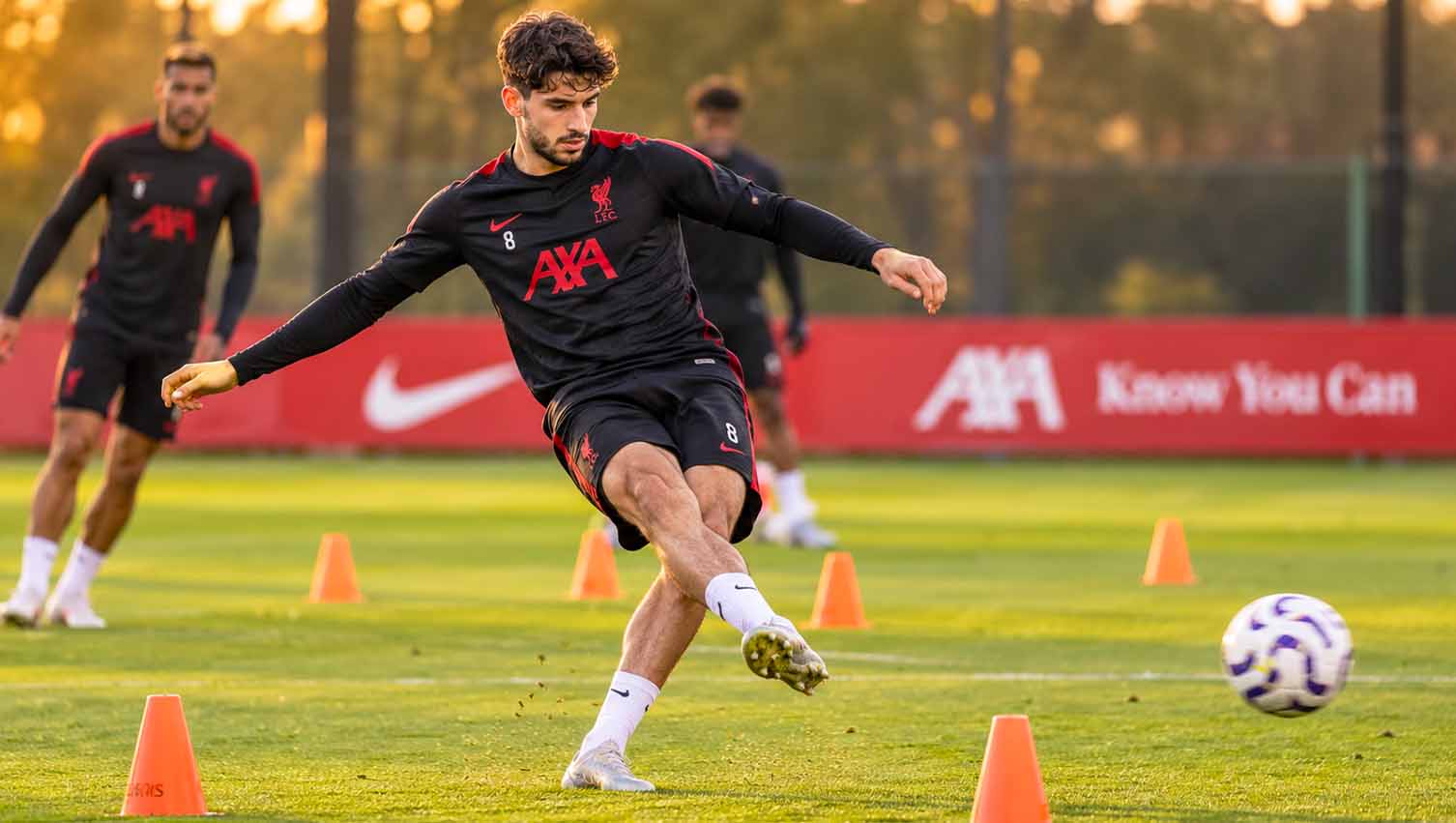
The average midfielder is not a lackluster player; rather they are not being trained to be one. Particularly fast passing, good first touch, good scanning and stamina to cover all the grass. These midfielder training drills target each of those areas with structure you can apply whether you are training alone, with a partner, or as part of a squad.
| Important Disclaimer
The exercises and training advice in this article are for general information purposes only. Always warm up properly before training. If you have any existing injuries or medical conditions, consult a qualified physiotherapist or sports doctor before starting any new training programme. VanoraHub is not responsible for any injuries sustained while following this guide. |
| Quick Answer
Midfielder training drills focus on passing accuracy, first touch, scanning, positional awareness, and stamina. Use drills like the passing triangle, half-turn receiving, and rondos regularly to improve your decision speed and ball retention in central midfield. |
What Makes a Good Midfielder?
A good midfielder controls tempo, wins the ball, and connects defence to attack under constant pressure. The position demands both technical precision and physical endurance. Research published in the International Journal of Sports Physiology and Performance (2018) found that central midfielders cover an average of 11 to 13 km per match, more than any other outfield position. Good technique without fitness, or fitness without good technique, leaves gaps a good team will exploit every time.
The drills below target what actually matters: passing, first touch, vision, positioning, and work rate.
Equipment Needed
- 10-20 training cones
- 4-6 training bibs
- 2-4 footballs per session
- Flat training poles (optional)
- Agility ladder
- Rebounder or training wall (for solo sessions)
1. Passing and Movement Triangle Drill
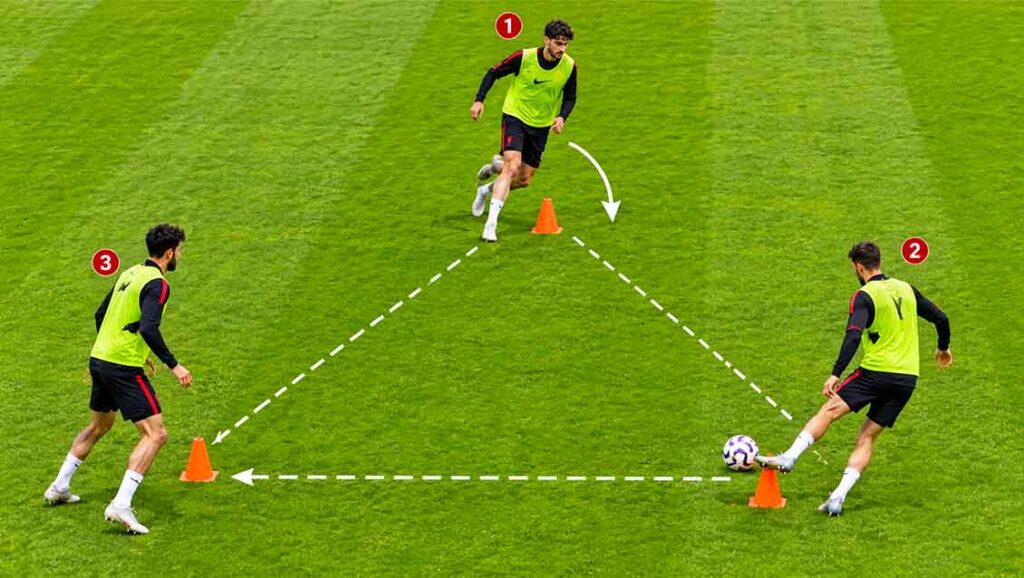
Three players play in a triangle, combining short passes and moving to a new cone after each pass. It involves training the give and go and getting into the habit of moving after the pass.
| Sets | Reps / Duration | Rest | Equipment | Difficulty | Football Benefit |
| 3 | 90 seconds | 30 sec | 3 cones, 1 ball | Beginner | Passing accuracy, movement off the ball |
How to do it:
- Place 3 cones in a triangle approximately 8 metres apart.
- Player A passes to Player B and immediately moves to Player B’s cone.
- Player B passes to Player C and moves to Player C’s cone.
- Player C passes to the cone Player A vacated and follows the ball.
- Continue for the full time.
- After 90 seconds, change the direction of play.
Common mistake: Players stand still after passing instead of moving to the next cone.
Coaching tip: Say the receiver’s name just before passing. It teaches communication and requires you to lift your head before you play the ball.
2. First-Touch and Ball-Control Drill
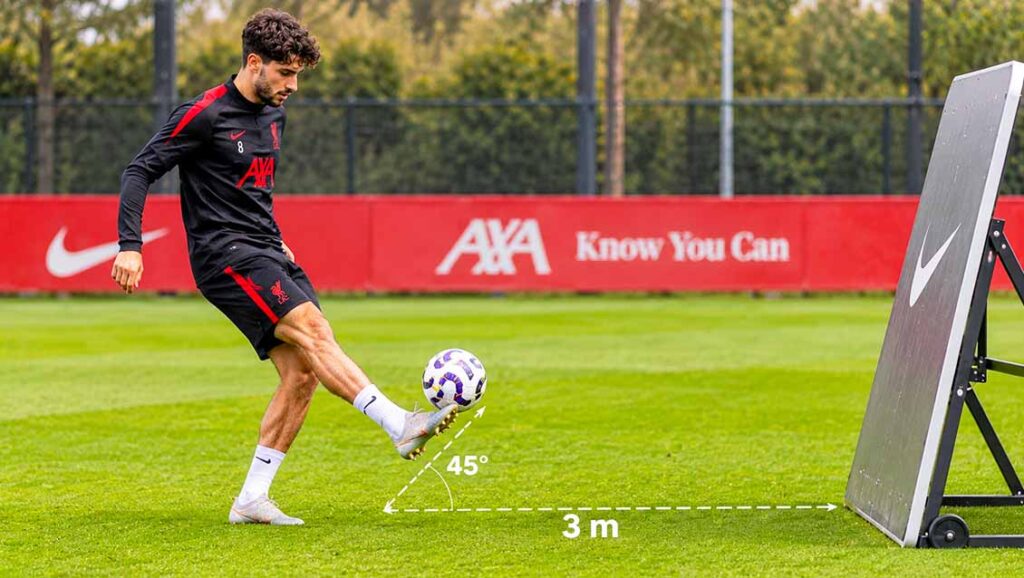
A solo drill to practise ball-receiving skills under time pressure, using a wall or rebounder. The key for midfielders who have time on the ball is their consistency with the first touch.
| Sets | Reps / Duration | Rest | Equipment | Difficulty | Football Benefit |
| 4 | 45 seconds | 20 sec | Rebounder or wall, 1 ball | Beginner | First touch, ball retention |
How to do it:
- Stand 3 metres away from a wall or rebounder.
- Pass the ball against the wall with your weaker foot.
- As it returns, control it with one touch using the inside of your stronger foot.
- Immediately pass it back with your stronger foot.
- Alternate feet every 15 seconds.
- Record and attempt to outdo the number of successful clean touches in a set.
Common mistake: Players use two touches to control the ball. Force yourself to one-touch control from the start.
Coaching tip: When run in, make sure your controlling foot is at a 45-degree angle. This is what will set the orientation of your body in the next pass.
3. Scanning Before Receiving Drill
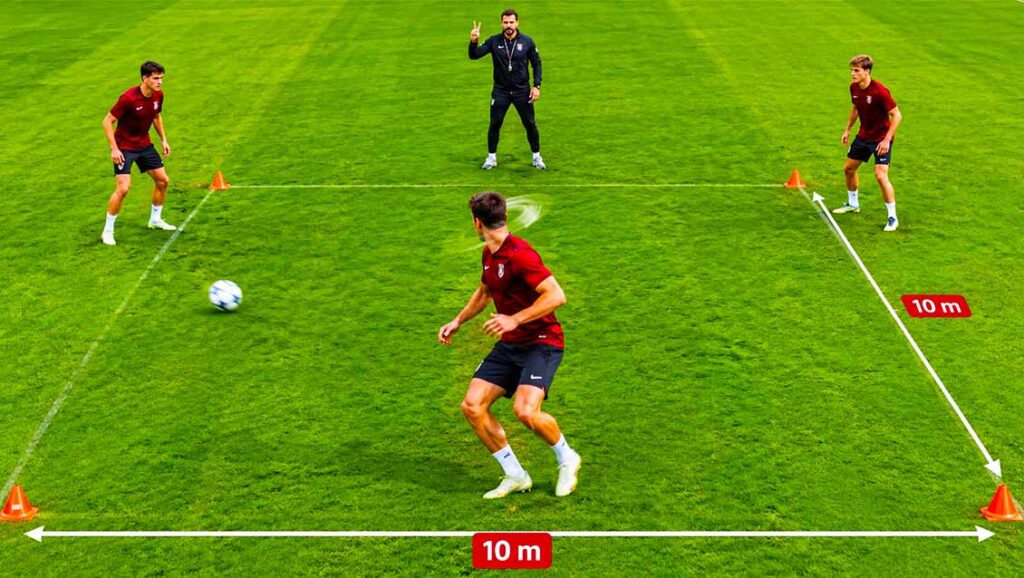
Drill for the habit of checking shoulders before receiving the ball. The authors of the Norwegian Football Federation (2012) study concluded that frequent scanning prior to receiving helps players make quicker and more precise decisions when faced with pressure.
| Sets | Reps / Duration | Rest | Equipment | Difficulty | Football Benefit |
| 3 | 10 reps each side | 30 sec | 4 cones, 1 ball, 2 partners | Intermediate | Awareness, decision-making |
How to do it:
- Using cones, mark a 10 metre square.
- Player A stands in the centre. Players B and C are at opposite corners.
- Before Player A receives, the coach or a third player holds up fingers behind Player A.
- Player A must check over their shoulder, call out the number, then receive and play to either Player B or C.
- The receiver then becomes the central player.
Common mistake: Players look to scan only after the ball is passed to them, not before.
Coaching tip: Get two head checks in before every pass reaches you. One early, one just before the ball arrives.
4. Rondo and Possession Drill
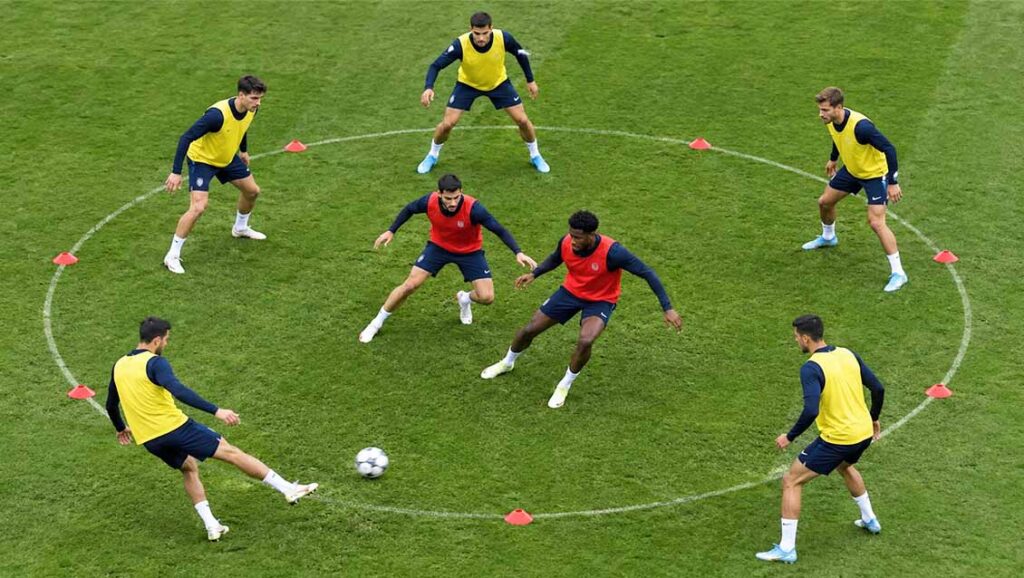
The rondo is a keep-ball exercise where two individuals are in the middle and attempt to get possession, and outside individuals maintain possession. Spatial awareness, press resistance and passing range are few drills that train as well.
| Sets | Reps / Duration | Rest | Equipment | Difficulty | Football Benefit |
| 5 | 3 minutes | 60 sec | Cones, 1 ball, 6-8 players | Intermediate | Possession, quick passing, pressing |
How to do it:
- Set up a circle or square approximately 10 metres wide with cones.
- 5-6 players work on the outside; 2 work in the middle.
- Outside players must keep possession with a maximum of 2 touches.
- If a central player wins the ball, the player who lost it switches into the middle.
- After 3 minutes, reduce touch limit to 1 for an advanced variation.
Common mistake: Outside players pass to the nearest player rather than the player who is in the greatest space.
Coaching tip: Ensure that outside players communicate verbally. The “turn” or “man on” is as crucial as the passing itself.
5. Receiving on the Half-Turn Drill
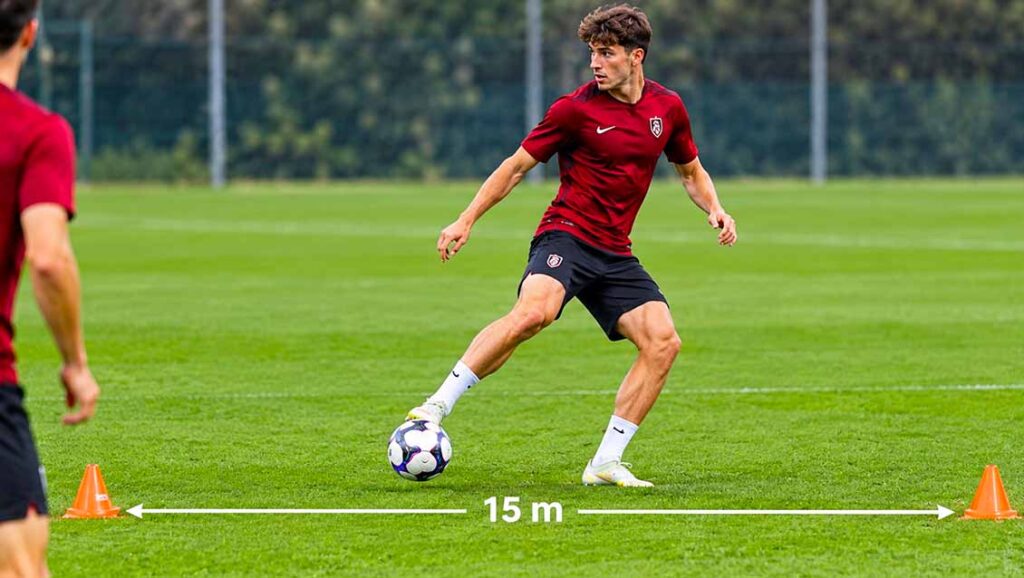
This drill helps midfielders learn to open their body shape before they receive the ball so they are able to play forward immediately upon the ball coming to them. One of the underutilized individual drills for midfielders.
| Sets | Reps / Duration | Rest | Equipment | Difficulty | Football Benefit |
| 4 | 8 reps per side | 30 sec | 2 cones, 1 partner, 1 ball | Intermediate | Body orientation, forward play |
How to do it:
- Place two cones 15 metres apart. Player A stands between them.
- Player B passes to Player A from behind cone 1.
- As the ball travels, Player A opens their hips to face forward, away from the passer.
- Player A receives on the half-turn using the back foot.
- Player A plays forward to cone 2 or to a third player positioned there.
- Reset and repeat from the opposite direction.
Common mistake: Players open their body too late, after the ball arrives. The body turn must happen during the ball’s travel.
Coaching tip: Consider your hips as your compass. The direction your hips face indicates where to play next.
6. Long-Passing Accuracy Drill
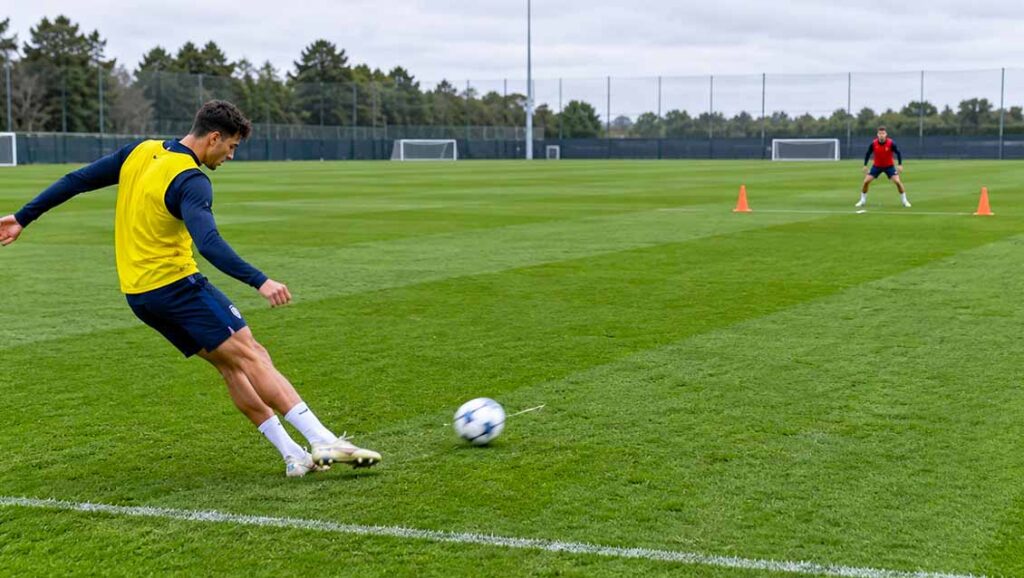
The ability to pass the ball long distances with precision makes ordinary central midfielders good ones. To develop the habit of driving through the middle of the ball to keep the ball on speed and in flight.
| Sets | Reps / Duration | Rest | Equipment | Difficulty | Football Benefit |
| 3 | 10 passes per side | 45 sec | Cones, 2 balls, 1 partner | Intermediate | Long pass accuracy, switching play |
How to do it:
- Mark two targets 30 metres apart using 4 cones each to form a 2-metre-wide gate.
- Player A stands behind cone target 1. Player B stands at target 2.
- Player A plays a driven pass aimed to pass through the gate to Player B.
- Player B controls and plays back.
- Record successful passes through the gate out of 10.
- In the advanced version, move on to 40 metres.
Common mistake: Players swing their leg at the ball rather than through the equator and the ball goes too high.
Coaching tip: At impact, keep your ankle locked, and slightly lean over the ball. Do not stand behind the ball with your foot on the ground.
7. Dribbling and Turning Under Pressure
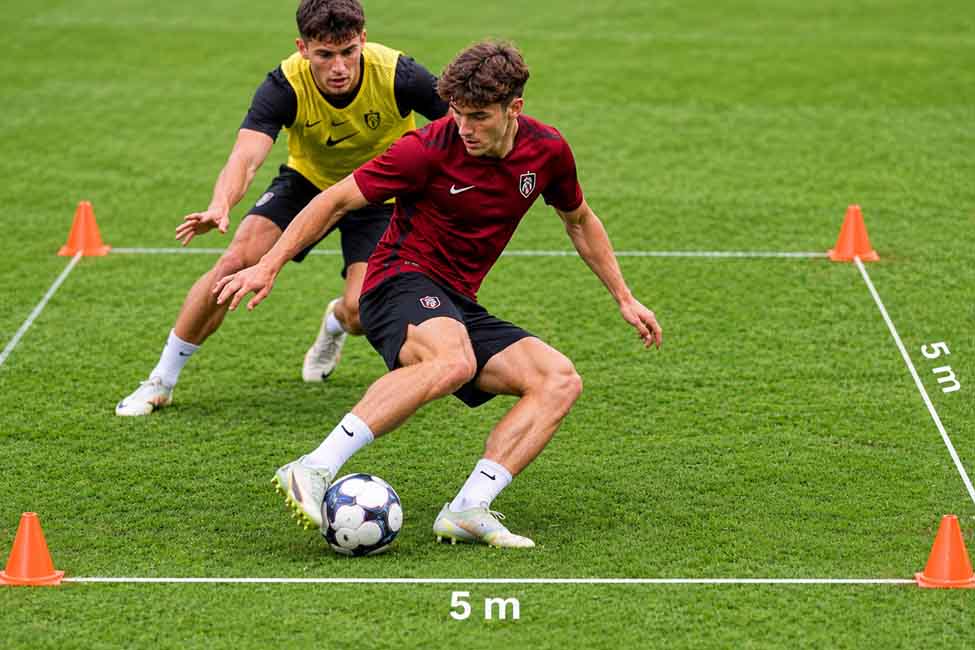
Midfielders who cannot turn with the ball under pressure get bypassed or dispossessed quickly. This drill replicates the moment a player receives the ball with an opponent close behind.
| Sets | Reps / Duration | Rest | Equipment | Difficulty | Football Benefit |
| 3 | 6 reps per turn type | 30 sec | 4 cones, 1 ball, 1 defender | Intermediate | Turning, close control, 1v1 |
How to do it:
- Mark a 5×5-metre box.
- Player A enters the box with the ball.
- A passive defender stands 1 metre behind Player A.
- Player A must execute a specific turn (Cruyff, hook, step over) and exit the box before the defender can close.
- After 6 reps, change the turn type.
- Progress to an active defender for the advanced version.
Common mistake: Players try to execute the turn before fully controlling the ball. Get a steady touch first.
Coaching tip: Fake before you turn. One shoulder drop before the actual turn gives you an extra half-second.
8. Defensive Midfielder Positioning Drill
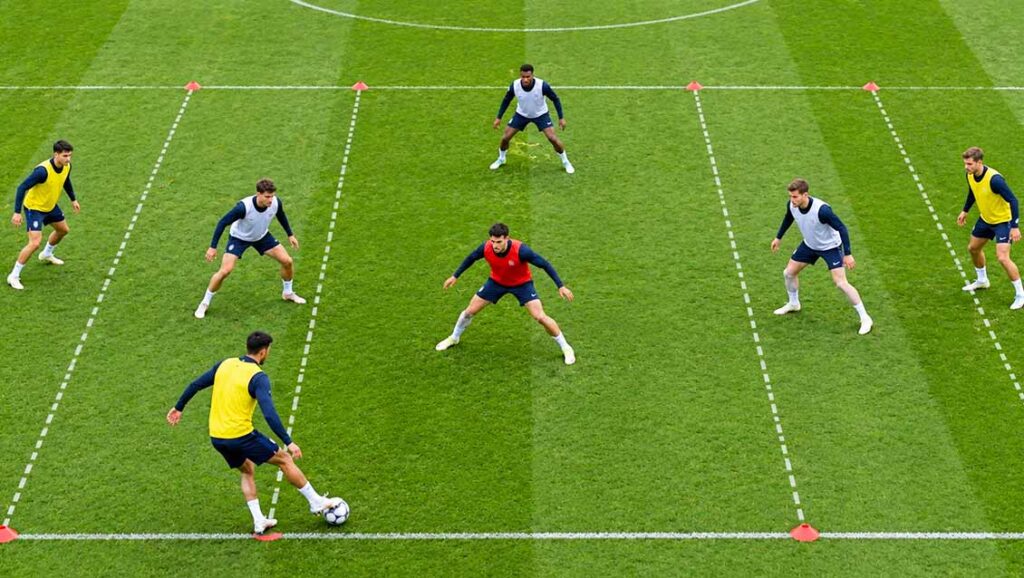
Players will practice this defensive midfielder training drill to learn to pick up passing lines, close them off and know when to press and when to stay in shape.
| Sets | Reps / Duration | Rest | Equipment | Difficulty | Football Benefit |
| 3 | 5 minutes per set | 90 sec | Cones, bibs, 8+ players | Advanced | Defensive shape, pressing triggers |
How to do it:
- Set up a half-pitch with two 5-player teams.
- The No. 6 (defensive midfielder) starts centrally between the lines.
- The attacking team tries to play through the middle.
- The No. 6 must cut off central passes by positioning between the ball and the striker.
- When the ball moves wide, the No. 6 shifts across while maintaining cover.
- Coach freezes play to discuss any positional errors.
Common mistake: The No. 6 jumps at the ball too early, leaving space in behind.
Coaching tip: Think about covering the passing line, not just the ball carrier. If you block the pass, you force the play wide.
9. Attacking Midfielder Movement Drill
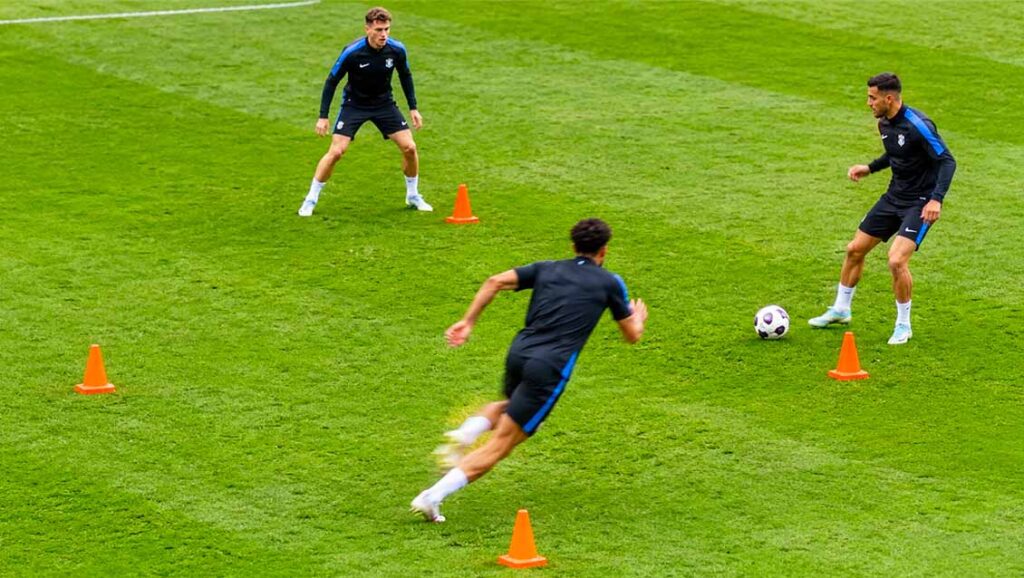
The attacking midfielders need to run in a way that they arrive in space at the right time. This drill is used to practice the movement patterns to lines and when to run the third man.
| Sets | Reps / Duration | Rest | Equipment | Difficulty | Football Benefit |
| 4 | 8 reps per movement | 30 sec | Cones, 2 partners, 1 ball | Advanced | Third-man runs, movement timing |
How to do it:
- Place four cones in a diamond 10 metres wide.
- Player A (Attacking midfielder) takes off from the bottom cone.
- Player B plays to Player C at the top cone.
- As Player B passes to Player C, Player A sprints to the top right or left cone.
- Player C lays off to the arriving Player A.
- Player A shoots or plays forward. Rotate positions after 8 reps.
Common mistake: Starting the run too early, arriving before the layoff and losing the run.
Coaching tip: Trigger your run from the moment you see your teammate about to receive, not when they already have the ball.
10. Box-to-Box Midfielder Fitness Drill
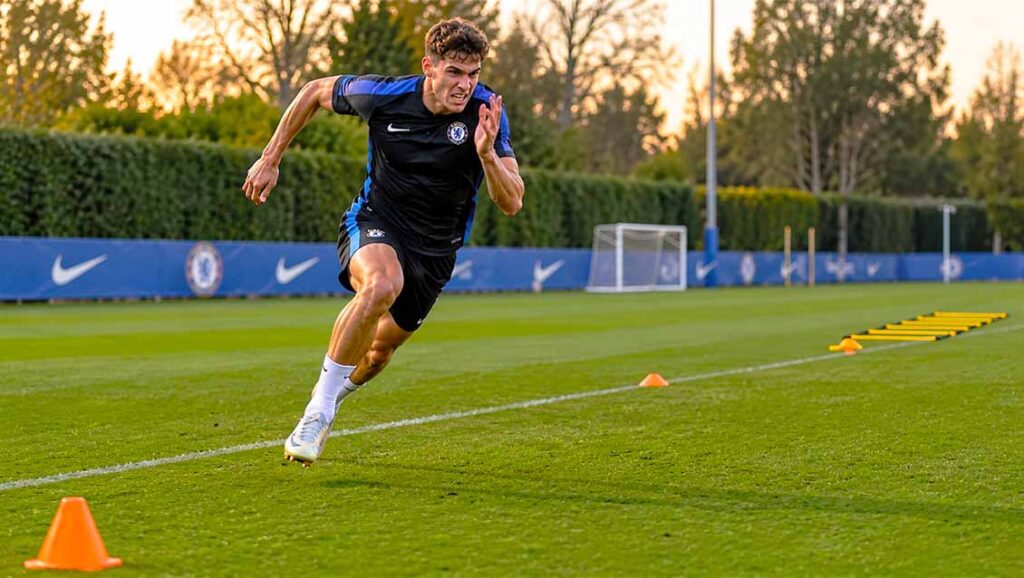
Box to box midfielders should have the stamina to run up and down the field and be able to sprint short distances many times. This drill is designed to simulate the physical requirements for covering 11 kilometres in 90 minutes.
| Sets | Reps / Duration | Rest | Equipment | Difficulty | Football Benefit |
| 5 | 60 seconds per rep | 60 sec | Cones, agility ladder | Advanced | Stamina, acceleration, agility |
How to do it:
- Set up a 40-metre straight with an agility ladder at one end.
- Sprint the full 40 metres.
- At the far end, complete one agility ladder sequence (high knees through every rung).
- Jog back to the start.
- After 60 seconds of active rest, repeat.
- Progress to 70 metres and reduce rest to 45 seconds in the advanced version.
Common mistake: Players slow down before they arrive at the far cone. Run the entire distance before slowing down.
Coaching tip: Sprint with arm drive.Improved arms, improved legs!
Individual Midfielder Training Without a Team
Teammates are not necessary to have for effective sessions. Solo drills with a wall, rebounder or cones: passing, first touch, fitness. Practise the first touch wall drill (Drill 2), long pass gate (Drill 6) and agility sprint (Drill 10). It’s a good routine to have three 40-50 minute sessions per week solo, without anyone else having to attend.
Sample Weekly Midfielder Training Plan
Use this plan to structure your week. Adjust based on your match schedule and recovery needs.
| Day | Session Focus | Drills |
| Monday | Technical | Drills 2, 5, 6 |
| Tuesday | Tactical | Drills 3, 8, 9 |
| Wednesday | Rest or Light Recovery | – |
| Thursday | Possession and Pressing | Drills 1, 4, 7 |
| Friday | Fitness | Drill 10 x6 |
| Saturday | Match or Full Session | Combine multiple drills |
| Sunday | Rest | – |
Common Midfielder Training Mistakes
Most midfielders make one of these training errors consistently:
- Skipping scanning drills because they feel artificial. Scanning becomes natural only through deliberate repetition.
- Overloading fitness at the expense of technique. Physical output means nothing if your passing breaks down at high intensity.
- Training only on your strong foot. One of the easiest to exploit weaknesses in a midfielder is a weak foot.
- Neglecting rest. High-intensity, back to back sessions with lack of recovery causes overuse injuries, especially to the hamstring and hip flexor.
Professional Tips
Former Barcelona and Spain midfielder Xavi Hernandez developed his scanning ability by having cones to focus on and checking left and right every time he was at a cone in passing exercises. A professional setup isn’t necessary to create a similar habit. Set a signal to give in your training session and constantly look over your shoulder as you approach it. The habit translates to match situations much quicker than most players think.
Frequently Asked Questions
How often should a midfielder train in a week?
Most amateur midfielders can benefit from four to five sessions a week. Avoid overloading one area by dividing sessions between technical (passing and first touch), tactical awareness and physical conditioning.
What are the best drills for improving vision as a midfielder?
Scanning drills like Drill 3 in this guide directly improve peripheral awareness. Research from the Norwegian Football Federation (2012) supports that regular scanning before receiving improves decision speed. Combine this with rondo drills that force quick choices under pressure.
Can I improve as a midfielder without a training partner?
Yes. Solo wall drills, cone gate passing, and agility runs cover passing technique, first touch, and fitness without any teammates. The first-touch rebounder drill requires no partner and can fill a 40-minute solo session on its own.
What is the difference between No. 6, No. 8, and No. 10 training priorities?
The No. 6 (defensive midfielder) is a player that emphasizes positioning, pressing triggers and covering passing lanes. The No. 8 (box-to-box) has to have both stamina and quality in transitions. The attacking midfielder (No. 10) is primarily tasked with creating time, getting in behind the defence and scoring in the final third.
How long does it take to see improvement from midfielder drills?
Most players notice improved first touch and passing accuracy within 4-6 weeks of consistent training, according to general sports science research on motor skill acquisition. Tactical improvements like scanning and positional awareness typically take 8-12 weeks of deliberate practice.
Conclusion
Midfield is not an easy position to play on the pitch, nor is it a place for the least talented, but it is perhaps the most rewarding position to master. Midfielder Training Drills in this Guide provide you with everything you need to work on the skills that really count: quick passing, precise 1st touch, good scanning, tactical positioning and fitness to sustain them for 90 minutes. Select 3 drills for this week. For the beginning student, begin with Drills 1, 2 and 3. For more advanced students, develop sessions around Drills 4, 5 and 10. Practice the drills repeatedly, monitor the accuracy goals and move on to the more complex versions when the simple ones are easy. There is no benefit to increasing the intensity of a single session to improve in the middle of the field. It is developed through repeated training over time of the appropriate things.
Sources
- Randers, M.B., et al. (2010). Application of four different football match analysis systems: a comparative study. Journal of Sports Sciences, 28(2). Referenced for physical demands of central midfield.
- Jordet, G., et al. (2012). Norway Football Research (Scanning and Decision Making). Norwegian Football Federation. Referenced in the scanning drill section.
- Stolen, T., et al. (2005). Physiology of Soccer. Sports Medicine, 35(6). Referenced in the fitness drill context.
