

This editorial watchlist was thoroughly updated on 7 November 2026. “Best” and “future star” are judgement-based labels, not guarantees of a player’s future career trajectory.
The search for the best U21 players 2026 offers a clear window into how modern football is evolving. Today’s elite young footballers are no longer restricted to speculative reserve cameos or late substitutions. Instead, teenagers and emerging talents are stepping directly into demanding tactical roles for Champions League contenders and heavyweight national teams.
Age eligibility cutoff for this 2026 watchlist: Players included in this editorial watchlist were under 21 on 1 January 2026. Several players—specifically Arda Güler, Kobbie Mainoo, and Désiré Doué—have turned 21 during the 2026 calendar year, while Leny Yoro turns 21 on 13 November 2026. This selection represents an independent editorial assessment based on verified top-flight consistency, tactical maturity, and competitive level, rather than an official FIFA or UEFA ranking.
Quick Answer: Who Are the Best U21 Football Players in 2026?
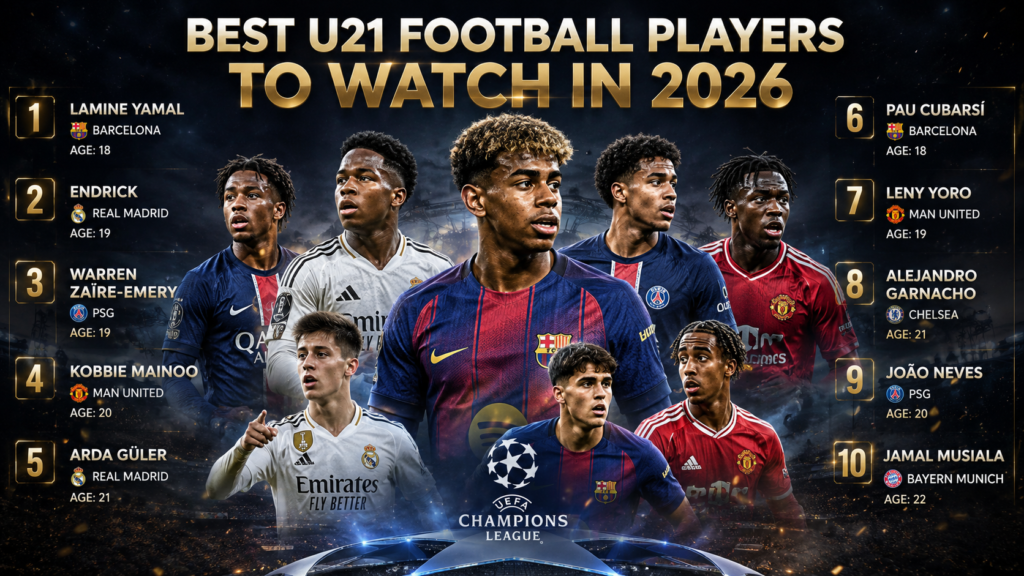
The standout best U21 players in world football right now combine elite technical execution with exceptional tactical maturity across Europe’s top five leagues:
- Lamine Yamal (Barcelona & Spain): The premier winger in world football under 21, providing world-class 1v1 dribbling, playmaking vision, and verified international silverware.
- Pau Cubarsí (Barcelona & Spain): The most composed young central defender in Europe, celebrated for elite line-breaking passing and positional intelligence under high press.
- Warren Zaïre-Emery (PSG & France): A tactically mature midfield controller who dictates tempo, initiates pressing triggers, and protects transitions in Champions League competition.
- Endrick (Real Madrid & Brazil): An explosive centre-forward possessing devastating short-area acceleration, physical ball shielding, and lethal finishing inside the penalty box.
- Arda Güler (Real Madrid & Turkey): A classical yet dynamic attacking playmaker gifted with an extraordinary left foot, tight-space dribbling, and dead-ball precision.
- Kobbie Mainoo (Manchester United & England): A press-resistant central midfielder with 360-degree spatial awareness, composed carrying, and disciplined positional timing.
- Désiré Doué (PSG & France): A dual-footed, explosive attacking winger who unbalances compact defensive blocks through direct take-ons and rapid change of direction.
- Leny Yoro (Manchester United & France): An athletic modern centre-back equipped with supreme recovery pace, aerial authority, and progressive distribution from deep.
What Sets These Top U21 Players Apart
Being exceptionally talented at 17 or 18 does not guarantee a world-class senior career. Most young players encounter predictable obstacles: their technical efficiency drops when confronted by intense pressing schemes, their physical output wanes after the 65th minute, and high-stakes away fixtures ruthlessly expose positional deficiencies that academy football rarely tests.
The players featured below have demonstrated an ability to navigate those difficult moments. Beyond raw highlights, each player exhibits high tactical intelligence, spatial composure when their side is pinned back, and the endurance to sustain performances over grueling 50-match club campaigns. When assessing the best young football players in the world 2026, positioning under defensive pressure reveals far more about their long-term ceiling than isolated goals or assists.
Selection Criteria: How We Evaluated Young Football Talents
To construct an objective, evidence-based watchlist of the highest potential U21 football players, we applied eight rigorous editorial criteria:
- Current Performance: Regular output, starting minutes, and measurable contributions across domestic leagues and European competitions.
- Technical Quality: Ball mastery under duress, first-touch security, passing accuracy under pressure, and finishing composure.
- Tactical Intelligence: Spatial awareness, off-the-ball movement, scanning frequency, and understanding of pressing and rest-defense structures.
- Consistency: The ability to deliver reliable performances across multiple matchdays rather than isolated flashes of brilliance.
- Competitive Level: Demands of the player’s domestic league (Premier League, La Liga, Ligue 1) and European competition (UEFA Champions League).
- International Experience: Verified senior caps and tournament participation with senior national federations.
- Development Potential: Measurable athletic ceiling, physical adaptability, and receptiveness to elite tactical coaching.
- Age Eligibility: Stated baseline cutoff requiring players to be under 21 years of age on 1 January 2026.
Comparison: Top 8 U21 Football Players to Watch in 2026
The following table summarizes the verified baseline details, positions, and tactical core strengths of each selected player as of 7 November 2026:
*Note: Players were under 21 on 1 January 2026. Arda Güler, Kobbie Mainoo, and Désiré Doué turned 21 during 2026; Leny Yoro turns 21 on 13 November 2026.
The Top U21 Football Players to Watch in 2026
Lamine Yamal | FC Barcelona & Spain | Born 2007
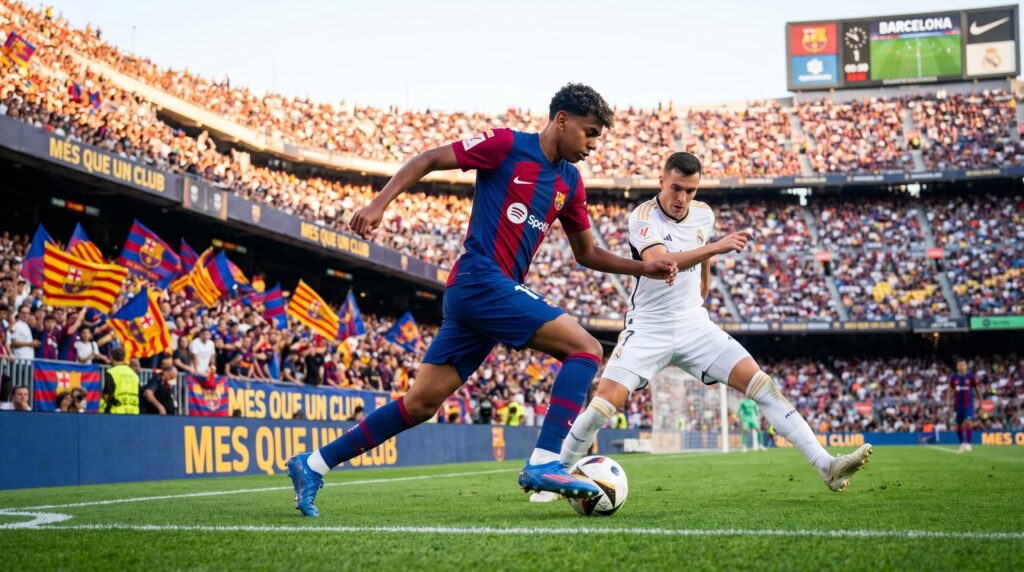
Watch any FC Barcelona build-up sequence and you will notice Lamine Yamal deciphering defensive pressing cues before opposing fullbacks have even committed their body weight. That cognitive anticipation—knowing instinctively when to accelerate into wide space, when to pause (la pausa), and when to release the ball early—is rarely seen in a 19-year-old. When exploring Lamine Yamal age and playing style, what separates him from standard teenage wingers is that his technical execution is matched by elite game management.
His historical breakthrough at UEFA Euro 2024, crowned by a breathtaking semifinal goal against France at age 16, established a lofty benchmark. Throughout the 2025/26 campaign and into the ongoing 2026/27 season under Hansi Flick, Lamine Yamal stats 2026 continue to rank in the upper 95th percentile among European wingers for progressive carries, key passes, and shot-creating actions per 90 minutes. In Spain’s campaign at the completed 2026 FIFA World Cup, he proved once again that high-stakes knockout football does not overwhelm his technical composure.
Playing Style and Tactical Responsibilities
Operating primarily as an inverted right winger, Yamal provides width in Barcelona’s attacking structure before cutting inside onto his favored left foot. Unlike touchline wingers who rely purely on linear speed, Yamal operates as an auxiliary wide playmaker. He routinely executes trivela passes, diagonal switches to the far post, and disguised through-balls between the opposing centre-back and left-back.
Key Technical and Tactical Strengths
- 1v1 Dribbling and Balance: Possesses a remarkably low center of gravity, allowing him to shift direction effortlessly without losing ball control.
- Playmaking Vision: Generates high expected assists (xA) through precision cutbacks and curled deliveries behind defensive backlines.
- Defensive Work Rate: Tracks back reliably in transition, supporting his right-back in defensive double-teams.
Weaknesses and Development Areas
Physical durability over a 60-game campaign remains the critical area to manage. While Yamal has developed lean muscle mass, physical fullbacks who press him aggressively before he turns can disrupt his rhythm. Maintaining tactical sharpness while avoiding muscle fatigue from congested domestic and European calendars is essential.
What to Monitor for the Rest of the 2026/27 Season
Track his goal-scoring efficiency inside the box and whether he can consistently convert high-volume shooting opportunities into double-digit league tallies, solidifying his status as the undisputed leader among the best young football talents in Europe 2026.
Pau Cubarsí | FC Barcelona & Spain | Born 2007
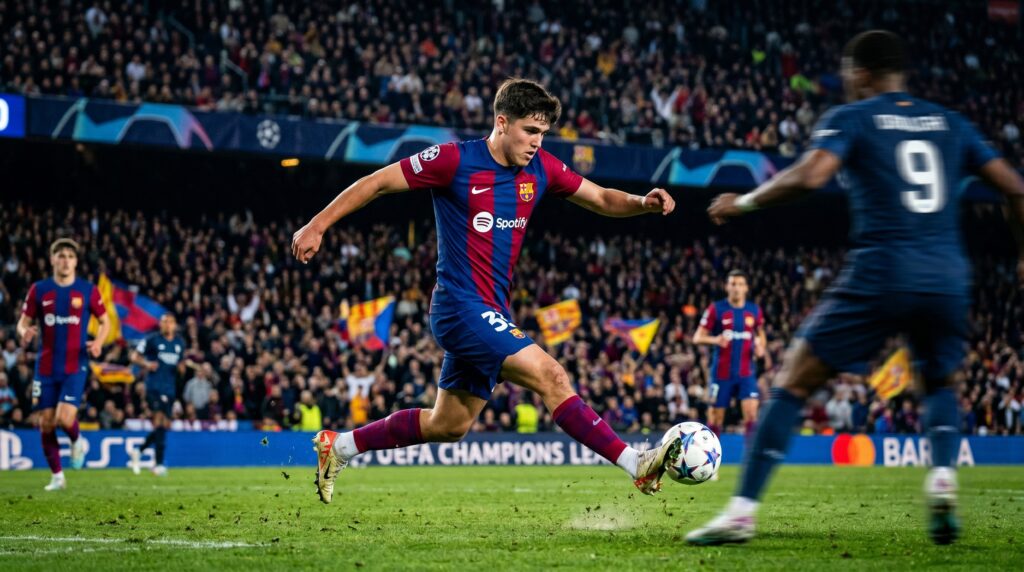
The most striking aspect of watching Pau Cubarsí is how seldom he appears to sprint. That is not a critique; it is a testament to extraordinary positional reading. By the time an opposing striker initiates a channel run, Cubarsí has already adjusted his defensive angle to intercept or shepherd the play away from danger. That spatial composure at age 19 in Champions League knockout ties is exceptionally rare.
For readers who have followed our in-depth Pau Cubarsí biography, his progression from La Masia to Olympic Gold medalist with Spain at Paris 2024 and first-choice centre-back for Barcelona is built on technical elegance. When evaluating Pau Cubarsi defending and passing ability, his numbers reflect a modern ball-playing defender: Pau Cubarsi stats 2026 show pass completion rates consistently hovering around 92%, with over 5.5 progressive passes per 90 minutes.
Playing Style and Tactical Responsibilities
Cubarsí anchors the central defensive line in Hansi Flick’s aggressive, high-line offside system. His primary tactical duty is stepping into the first phase of build-up to break opposition pressing lines. Rather than clearing long under pressure, he drives forward into midfield channels to supply line-breaking vertical passes directly to the attacking midfielders.
Key Technical and Tactical Strengths
- Vertical Passing: Uncanny ability to drill flat, accurate passes between lines of opposing midfielders.
- Tackle Timing: Rarely commits rash fouls; relies on clean standing tackles and ball-recovery interceptions.
- Composure Under High Press: Remains ice-cool when pressed inside his own penalty area, opening passing lanes with clever body feints.
Weaknesses and Development Areas
Against physically imposing, classic 6’3″ target forwards, positional anticipation must be complemented by upper-body strength. Continuing to develop physical resilience in sustained aerial battles remains his main development pathway.
What to Monitor for the Rest of the 2026/27 Season
Monitor his aerial duel success percentage against physical European competition and his communication in holding Barcelona’s coordinated high defensive line against elite counter-attacking sides. Compare his development with our comprehensive ranking of the top upcoming defenders to watch in 2026.
Warren Zaïre-Emery | Paris Saint-Germain & France | Born 2006
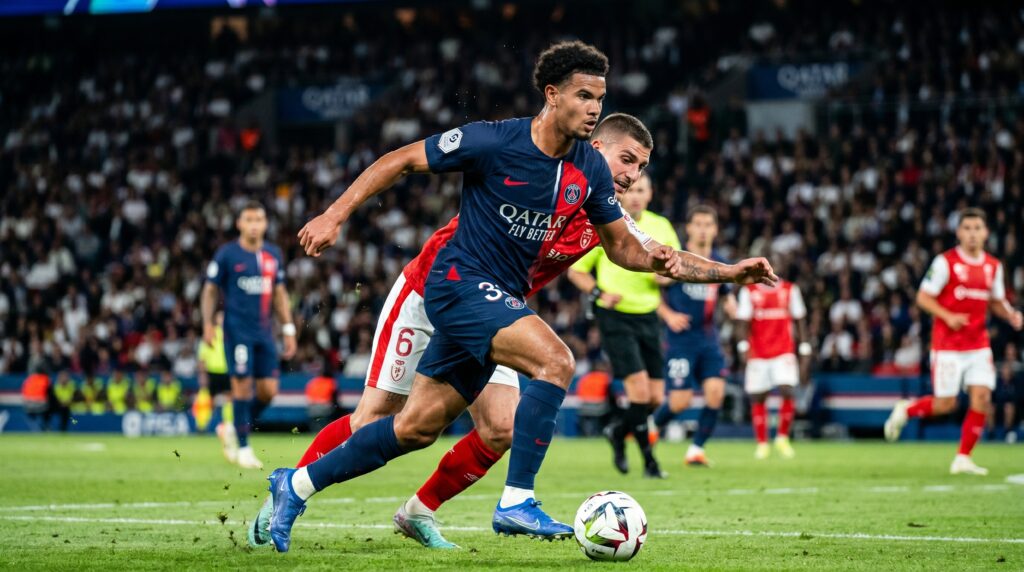
You rarely see viral highlight clips of Warren Zaïre-Emery attempting fifty-yard diagonal curlers or rabonas. That understated efficiency is precisely why Luis Enrique entrusts him with enormous tactical responsibility at Paris Saint-Germain. Zaïre-Emery is a master controller: he dictates team tempo, coordinates pressing structures, and transitions PSG from defensive solidity into fluid attacking sequences with minimal fuss.
Analyzing Warren Zaire Emery playing style and position reveals a complete box-to-box midfielder with an elite physical engine. Warren Zaire Emery stats 2026 demonstrate his importance to PSG’s spine: high pass accuracy under pressure (over 91%), elite defensive ground-duel success, and frequent high-turnover recoveries in the middle third. For France’s national setup, he represents the natural evolution of midfield controllers, having featured in the 2026 World Cup squad after gaining senior experience at Euro 2024.
Playing Style and Tactical Responsibilities
Zaïre-Emery serves as the connective tissue of PSG’s three-man midfield. He initiates pressing triggers, recovers loose second balls, and acts as the safety valve whenever PSG’s fullbacks push high into attacking thirds. His ability to shield the ball using his broad shoulders and upper-body leverage allows him to turn away from tight double-teams safely.
Key Technical and Tactical Strengths
- Press Resistance: Possesses elite physical strength and balance, making it virtually impossible for opponents to dispossess him from behind.
- Tactical Discipline: Maintains positional awareness, rarely vacating central corridors recklessly.
- Transitional Carrying: Drives dynamically through central midfield when open lanes present themselves.
Weaknesses and Development Areas
Incision in the final third remains his primary area for expansion. While his short combination play is immaculate, increasing his direct shot output from the edge of the penalty box and delivering key through-balls against deep low blocks would elevate his profile to truly world-class status.
What to Monitor for the Rest of the 2026/27 Season
Watch his offensive goal and assist returns in Champions League knockout fixtures as PSG continues to rely on his leadership in midfield.
Endrick | Real Madrid & Brazil | Born 2006
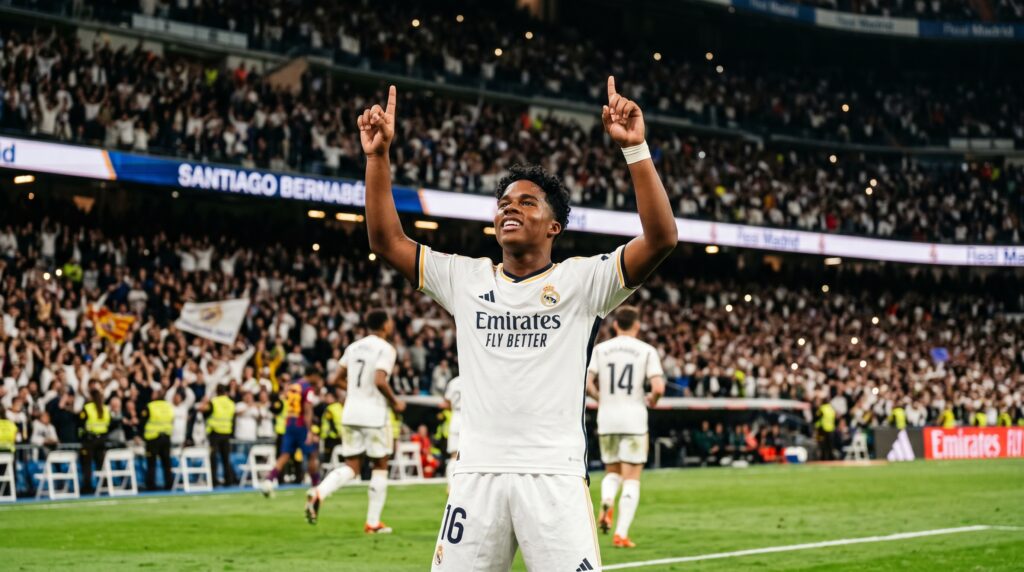
Instinct inside the 18-yard box cannot be taught on a tactical whiteboard; you either have it or you do not. Endrick possesses that predatory forward instinct in abundance. He anticipates second balls faster than nearly any other young forward in world football, adjusting his stride and body shape before crosses are delivered rather than reacting after the fact.
Examining Endrick goals and Real Madrid career illustrates the demands of competing in one of football’s most crowded attacking rosters. Since arriving from Palmeiras in summer 2024, Endrick has maximized high-impact substitute minutes and rotated starts. Endrick stats 2026 highlight extraordinary goal-per-minute efficiency in La Liga and the Champions League. Having already scored high-profile international goals for Brazil against England at Wembley and Spain at the Bernabéu, his role at the 2026 World Cup highlighted his value as an explosive tournament match-winner.
Playing Style and Tactical Responsibilities
Endrick is a dynamic, stocky centre-forward whose physical burst over 10 to 15 yards catches defenders flat-footed. He does not require extensive touches to make an impact. Instead, he specializes in rapid combination wall-passes, spinning behind centre-backs, and unleashing sudden, powerful shots with minimal backlift on his favored left foot.
Key Technical and Tactical Strengths
- Lethal Ball-Striking: Generates extreme shot velocity from tight angles with virtually no backlift, catching goalkeepers off-guard.
- Short-Area Acceleration: Explodes across the first three yards to beat defenders to loose balls in the six-yard box.
- Physical Shielding: Uses a sturdy lower body to hold off taller defenders with his back to goal.
Weaknesses and Development Areas
Sustained involvement in prolonged possession phases remains a work in progress. When Real Madrid faces ultra-compact defensive low blocks, Endrick can occasionally become isolated. Developing patience and refining his associative link-up play in tight midfield spaces will broaden his influence.
What to Monitor for the Rest of the 2026/27 Season
Monitor his starting minutes in La Liga and his progression toward becoming Real Madrid’s primary tactical number nine. Explore our dedicated analysis of the best 15 young strikers in world football 2026 to see how Endrick compares with other elite emerging goalscorers.
Arda Güler | Real Madrid & Turkey | Born 2005
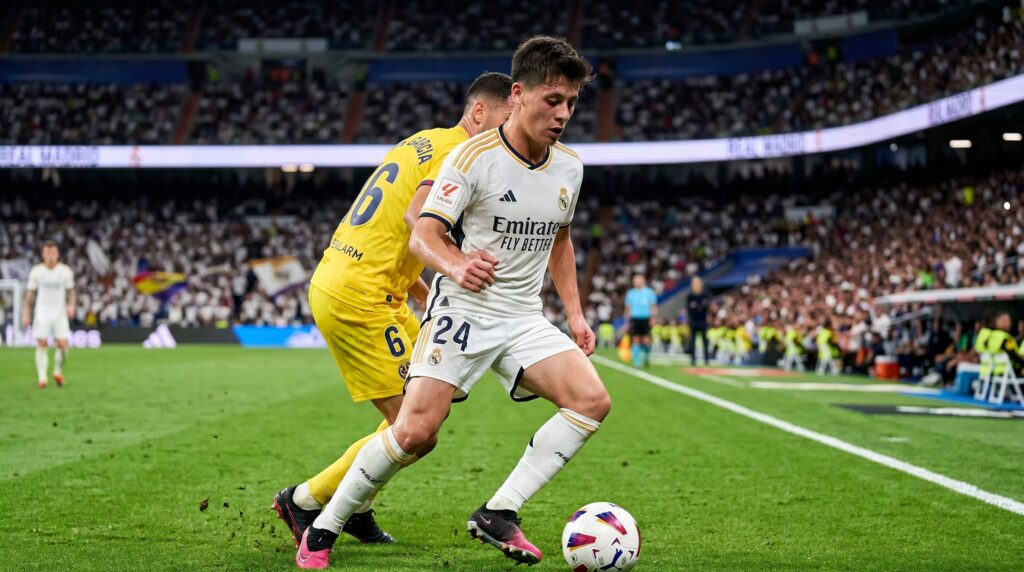
That cultured left foot remains one of the purest weapons in European football. When Real Madrid committed a significant investment to sign Arda Güler from Fenerbahçe at age 18, expectations were sky-high. Following his memorable showing at UEFA Euro 2024—including that sensational curling strike against Georgia—Güler has converted his promise into verified senior production.
Understanding Arda Guler position and playing style requires looking beyond raw physical speed. Güler plays with a cerebral tempo. Arda Guler stats 2026 underline his creative brilliance: high conversion rates from edge-of-the-box attempts, elite pass completion in the final third, and outstanding set-piece deliveries. As Turkey’s creative centerpiece at the 2026 World Cup, his playmaking vision unlocked tight international defenses.
Playing Style and Tactical Responsibilities
Whether deployed as an inverted right winger who drifts inside onto his left foot or as a central attacking playmaker behind the strikers, Güler thrives in the half-spaces. He receives the ball on the half-turn, bypassing defensive lines with subtle body swerves and delivering delicately weighted through-balls for advancing wingers.
Key Technical and Tactical Strengths
- Shooting Precision: Exceptional curling technique from outside the 18-yard box into the top corners.
- Vision in Tight Windows: Spots delayed third-man runs that standard playmakers overlook.
- Dead-Ball Delivery: Consistently creates high-xG opportunities from direct free kicks and corners.
Weaknesses and Development Areas
Maintaining high-intensity physical pressing over 90 minutes against dynamic, athletic opposition remains his main growth area. Ensuring muscular resilience against physical challenges will allow him to dominate matches continuously.
What to Monitor for the Rest of the 2026/27 Season
Track his total starting appearances for Real Madrid and his impact in direct Champions League encounters against Europe’s top midfield units.
Kobbie Mainoo | Manchester United & England | Born 2005
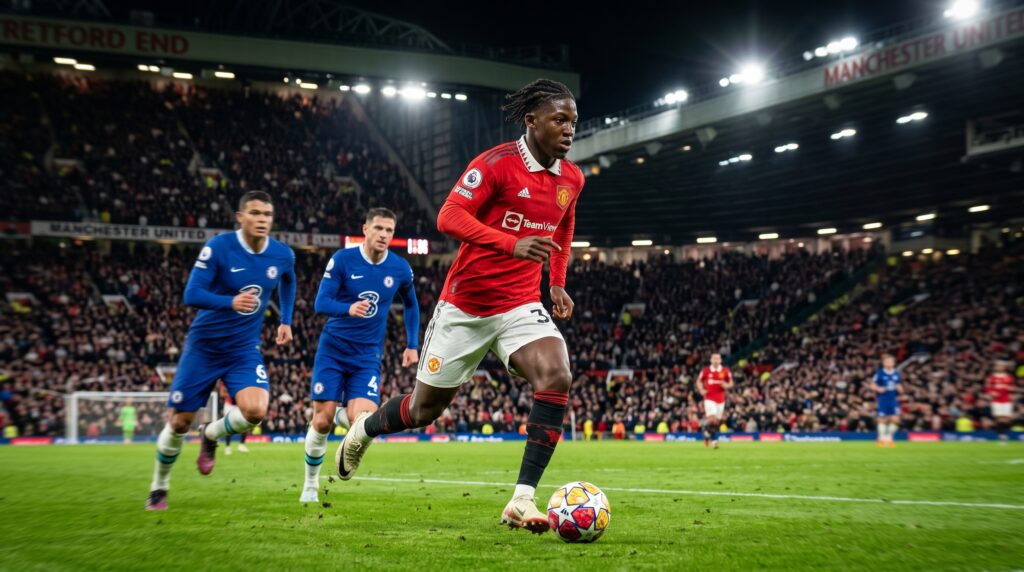
Most young central midfielders fall into one of two tactical traps: they either sit excessively deep out of fear of making mistakes, or they overcommit to pressing and leave catastrophic voids in behind. Kobbie Mainoo consistently avoids both errors. His positional discipline and scanning frequency before receiving the ball represent the hallmarks of a seasoned midfield general.
A detailed examination of Kobbie Mainoo strengths and weaknesses highlights his press resistance. After scoring the winning goal in the 2024 FA Cup final and starting every knockout match for England en route to the Euro 2024 final, Kobbie Mainoo stats 2026 confirm his status as Manchester United’s midfield fulcrum. During the 2026 World Cup, his composure helped England control possession under intense pressure in high-stakes knockout rounds.
Playing Style and Tactical Responsibilities
Mainoo operates as a press-resistant number eight or double-pivot controller. His signature maneuver is receiving the ball on his back foot while under heavy pressure, dropping his shoulder, and rolling away from the marker into open space. He links defense to attack with crisp, ground-level passes, dictating the tempo of Manchester United’s transitions.
Key Technical and Tactical Strengths
- 360-Degree Spatial Awareness: Scans over his shoulders continuously, allowing him to evade challenges before opponents make contact.
- Composure in High-Pressure Scenarios: Rarely panics inside his own defensive third; comfortable absorbing contact to earn fouls.
- Forward Ball-Carrying: Breaks lines through controlled, purposeful driving runs through midfield corridors.
Weaknesses and Development Areas
Top-end recovery sprint speed when defending extensive open spaces in transitional counter-attacks can occasionally leave him stretched. Improving defensive recovery angles and expanding his aerial duel success will complete his skill set.
What to Monitor for the Rest of the 2026/27 Season
Watch how effectively he dictates tempo against Premier League top-four rivals and whether his progressive passing into the penalty box continues to rise.
Désiré Doué | Paris Saint-Germain & France | Born 2005
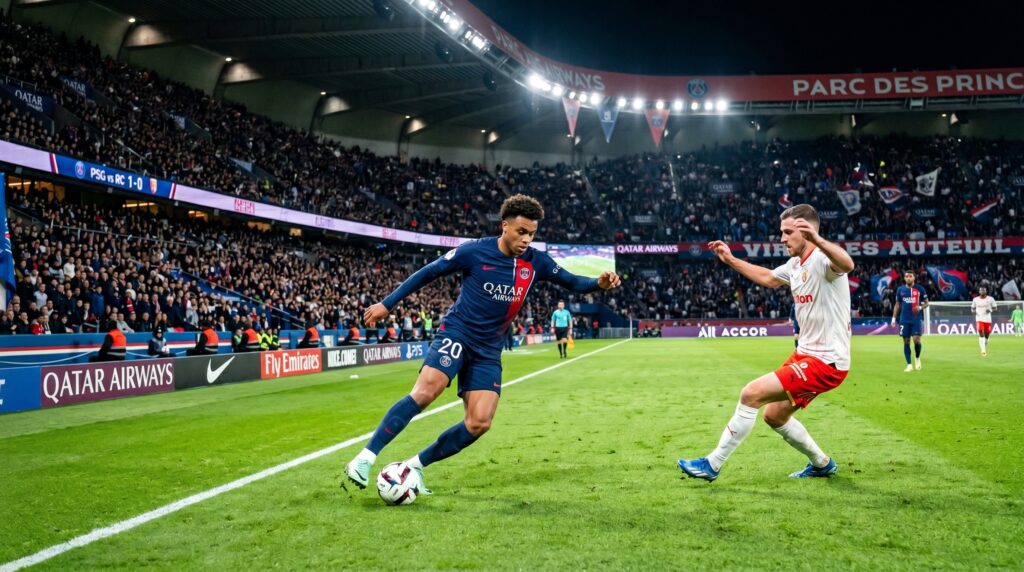
Following his high-profile €50 million transfer from Rennes to Paris Saint-Germain in August 2024 and an Olympic Silver medal with France at Paris 2024, Désiré Doué has steadily established himself as one of Europe’s most electrifying wide attackers. His dribbling style is exceptionally direct: he does not stall or delay; he attacks defenders aggressively at full pace.
Analyzing Desire Doue goals and playing style highlights his unique dual-footed ball manipulation. When reviewing Desire Doue stats 2026, his metrics for progressive carries, successful take-ons, and fouls drawn in the attacking third rank near the top of Ligue 1. While his inclusion in France’s competitive senior squad reflects his soaring reputation, the next phase of his career demands ruthless consistency in front of goal.
Playing Style and Tactical Responsibilities
Doué primarily lines up on the left wing for Luis Enrique, though he is equally capable of operating as an inverted number ten. He isolates fullbacks in 1v1 duels, using sudden deceleration followed by an explosive burst to either cut inside for a shot or drive toward the byline for a cross.
Key Technical and Tactical Strengths
- Dual-Footed Mastery: Equally dangerous shooting and crossing with either his left or right foot.
- Explosive Acceleration from Standstill: Unbalances defenders through sudden shifts of weight and quick acceleration.
- Attacking Aggression: Unafraid of taking risks in congested penalty areas.
Weaknesses and Development Areas
Decision-making timing in the final third remains his primary developmental focus. Learning when to release the ball to open teammates rather than attempting an extra take-on will substantially increase his goal contributions.
What to Monitor for the Rest of the 2026/27 Season
Observe whether Doué can establish a permanent starting role on PSG’s left flank during Champions League knockout fixtures.
Leny Yoro | Manchester United & France | Born 2005
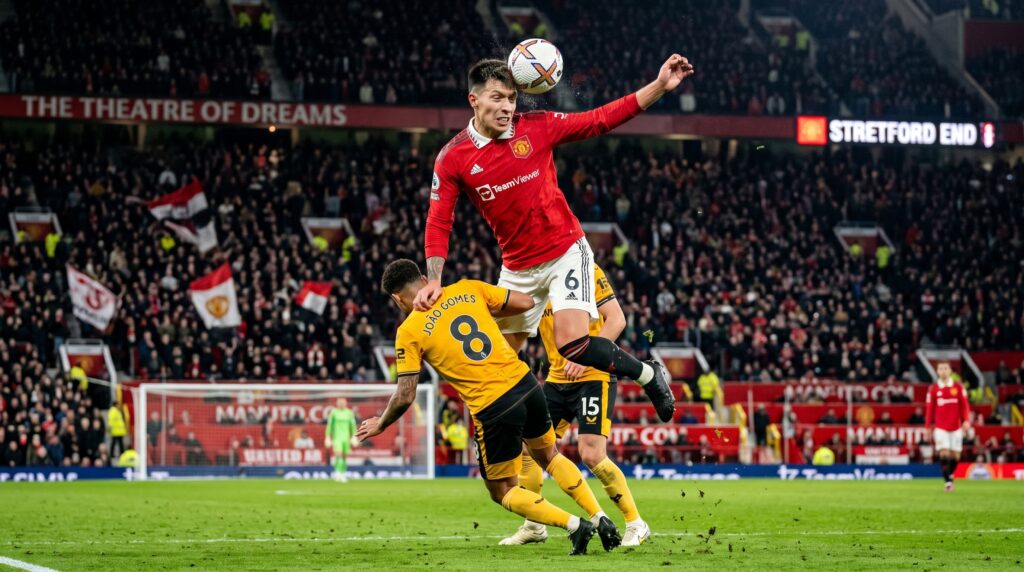
When Manchester United secured Leny Yoro from Lille in summer 2024 for €62 million, European football scouts recognized the signing of a generational defensive prototype. After overcoming early injury adversity during his debut English campaign, Yoro has established himself as the athletic foundation of Manchester United’s backline.
A thorough evaluation of Leny Yoro defensive strengths and potential reveals an elegant, long-striding centre-back who pairs modern distribution with elite recovery pace. Leny Yoro stats 2026 demonstrate high success in aerial duels (over 68%), exceptional tackle-timing in transition, and top-tier composure when passing out under intense Premier League pressing.
Playing Style and Tactical Responsibilities
Yoro provides Manchester United with the athletic security required to deploy a proactive, high defensive line. His closing speed enables him to snuff out counter-attacks before opposing strikers enter the penalty area. In possession, his long, upright posture gives him clear sightlines to hit diagonal crossfield passes to advancing wingers.
Key Technical and Tactical Strengths
- Elite Recovery Pace: Covers defensive depth effortlessly, neutralising opposing through-balls with rapid sprint recoveries.
- Aerial Authority: Combines tall physical reach with calculated jump timing to dominate defensive set-pieces.
- Clean Tackling Technique: Relies on long levers to execute precise, wrap-around challenges without conceding penalties.
Weaknesses and Development Areas
Physical durability across an uninterrupted 50-game English season represents his most urgent priority. Bulking up to withstand physical duels against Premier League target men without sacrificing his mobility is his ongoing tactical objective.
What to Monitor for the Rest of the 2026/27 Season
Track his match availability, physical resilience, and leadership role in Premier League fixtures. For a broader perspective on Europe’s best young defensive talents, review our rankings of upcoming defenders to watch in 2026.
Best U21 Players by Position in Football
To provide a structured overview for tactical analysts and scouts, here is how the top under-21 talents categorize by tactical role across world football:
Best U21 Attacking Players & Wingers
The attacking category is spearheaded by Lamine Yamal and Endrick, followed closely by Désiré Doué. Yamal sets the global standard for creative wing play, while Endrick offers unmatched penalty-box dynamism. Doué provides verticality and explosive take-ons. Together, they represent the vanguard of modern, multi-functional attacking football. For deeper analysis of goalscorers, explore our shortlist of the best young strikers in football.
Best U21 Midfielders & Controllers
In midfield, Warren Zaïre-Emery and Kobbie Mainoo demonstrate that teenagers can manage the most demanding zones of the pitch with supreme composure. Zaïre-Emery excels in tempo control, defensive pressing triggers, and ball security, while Mainoo specializes in tight-space evasions, scanning, and progressive carrying. Alongside them, Arda Güler provides pure attacking creativity, half-space incision, and dead-ball mastery.
Best U21 Central Defenders
The defensive department is anchored by Barcelona’s Pau Cubarsí and Manchester United’s Leny Yoro. Cubarsí is the definitive ball-playing centre-back, relying on spatial anticipation and line-breaking passing. Yoro provides the athletic antidote with supreme recovery pace and aerial dominance. Both represent the blueprint for modern central defenders required to operate in aggressive, high-line tactical systems.
Emerging Football Talents on the Radar: Who Else to Watch
Beyond our primary top 8 watchlist, several extraordinary young players under 21 are rapidly building cases for inclusion among world football’s elite:
- Kenan Yıldız (Juventus & Turkey, Born May 2005): A dynamic second striker and attacking midfielder gifted with sublime close control, direct running, and sharp finishing in Serie A.
- Estêvão Willian (Palmeiras / Chelsea, Born April 2007): A dazzling Brazilian winger whose agility, explosive acceleration, and direct take-ons have marked him as one of South America’s most exciting exports.
- Franco Mastantuono (River Plate, Born August 2007): An Argentine attacking prodigy possessing technical balance, vision, and dead-ball precision that have attracted Europe’s heavyweight scouts.
2026 FIFA World Cup: Historical Review and Development Lessons
The 2026 FIFA World Cup ran from 11 June to 19 July across 16 host cities in Canada, Mexico, and the United States. It is now a completed historical tournament, not an upcoming audition for this young generation.
When reviewing how young players performed at the tournament, serious analysts must separate selection from actual competitive impact. Participating in a month-long international tournament places unique physical and psychological demands on young footballers: tactical structures are condensed, recovery windows are compressed, and individual errors carry tournament-ending consequences.
However, an isolated strong substitute cameo or tournament goal does not automatically prove a player has achieved world-class stature, nor does a quiet tournament define a young player’s ceiling. To evaluate young talent accurately, tournament contributions must always be cross-referenced with a full 50-game domestic season where tactical consistency, weekly recovery, and league adaptability are rigorously tested.
How to Objectively Track U21 Player Development
Scouting young footballers requires looking far beyond viral social media highlights and box-score statistics. A player’s standout moments in a comfortable 4-0 home win provide virtually zero development signal. To track U21 development objectively, evaluate the following three pillars:
- Performance in Adverse Away Environments: Watch how young players react when their team falls behind in hostile away fixtures. Do they maintain defensive shape, or do they drop their heads and avoid receiving passes under pressure?
- Underlying Analytical Metrics: Utilize platforms like FBref and Sofascore to track progressive metrics: passes into the penalty area, successful pressures completed, progressive carries, and aerial duel win percentages. For athletic benchmarks, assess physical acceleration using our Football Sprint Speed Calculator.
- Structured Physical Development: Observe whether young players are adding lean physical strength without sacrificing flexibility and explosive mobility. Long-term durability is fostered through disciplined conditioning, such as the principles outlined in our Home Football Training Plan for Young Players.
Conclusion
The best U21 players 2026 are not merely prospects waiting for their careers to begin. Lamine Yamal, Pau Cubarsí, Warren Zaïre-Emery, Endrick, Arda Güler, Kobbie Mainoo, Désiré Doué, and Leny Yoro are already shaping the tactical landscape of European and international football today.
As the 2026/27 campaign progresses toward its business end, prioritize following their week-to-week consistency, physical resilience, and decision-making in high-pressure matches. The players who turn early promise into enduring world-class careers are those who deliver when the lights are brightest and the tactical margins are smallest.
Frequently Asked Questions (FAQ)
Who is the best U21 player in the world in 2026?
Lamine Yamal is widely regarded by coaches, scouts, and analysts as the best U21 player in world football in 2026. At 19 years old, he is a permanent first-choice starter for both FC Barcelona and Spain, delivering elite goal and assist numbers while showcasing world-class playmaking vision and verified international silverware.
What does U21 mean in football?
In football terminology, U21 means Under 21, referring to players aged 21 or younger based on a specific eligibility cutoff. For official competitions like the UEFA European Under-21 Championship, fixed calendar birth dates are used (such as 1 January 2004 for the 2025–27 cycle), meaning players can legally remain eligible even after celebrating their 21st birthday. This editorial watchlist uses an explicit cutoff of 1 January 2026.
Which U21 midfielder is the most complete in Europe right now?
Warren Zaïre-Emery and Kobbie Mainoo represent the two most complete U21 central midfielders in Europe. Zaïre-Emery holds a slight edge in physical pressing intensity, defensive tempo control, and Champions League responsibility for PSG, while Mainoo stands out for silky press resistance, spatial scanning, and composure in tight central corridors for Manchester United and England.
Are there standout U21 central defenders worth following closely?
Yes. Pau Cubarsí at FC Barcelona and Leny Yoro at Manchester United are the two premier U21 centre-backs in the game. Cubarsí is the definitive ball-playing defender who excels at breaking pressing lines with vertical passes, while Yoro provides supreme recovery pace, aerial authority, and modern athletic dominance.
How should young players’ 2026 World Cup performances be assessed?
Always evaluate 2026 World Cup contributions through the lens of actual minutes, assigned tactical roles, and competition context, rather than headlines alone. A squad call-up or brief late cameo does not prove senior readiness; compare international tournament output with sustained multi-month form in European club competitions.
Which young footballers could improve the most during the 2026/27 season?
Arda Güler and Leny Yoro possess the highest growth ceilings for the remainder of the 2026/27 season. With regular starting minutes and freedom from injury setbacks, Güler has the technical talent to become Europe’s foremost attacking playmaker, while Yoro can firmly establish himself as a top-five central defender in world football.
Compare development across positions with our comprehensive watchlists of upcoming defenders, young strikers and young goalkeepers. These are independent editorial selections, not official rankings; assess each player’s role and opportunities as well as headline statistics.

10 comments on “Best U21 Players to Watch in 2026: Top 8 Young Talents”