
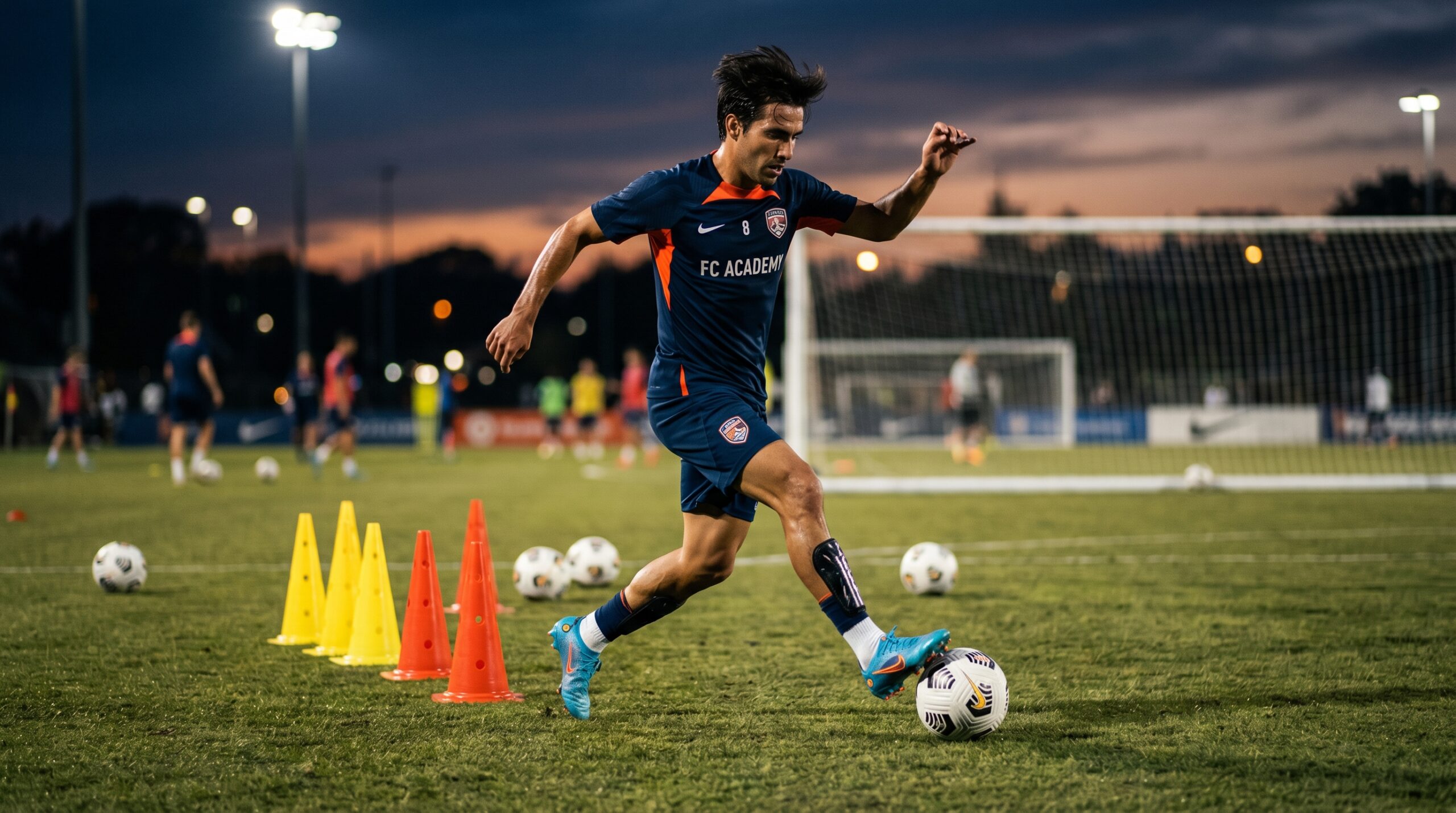
Ball control is the one skill that sets average players apart from great ones, whether you’re just starting or have been playing for a few years. When you watch Messi, Iniesta, or De Bruyne play football, you’ll notice right away that the ball sticks to them. It doesn’t bounce off. It doesn’t go out of their reach. It does what they want it to do.
What’s the good news? That level of control isn’t magic. It comes from practicing on purpose, doing the right drills, and knowing how to do things the right way. This guide will show you 10 useful football ball-control drills you can start doing right away. All you need is a ball, some space, and the will to do them.
By the end, you’ll be able to control the ball better in football, improve your first touch, and get better at dribbling, whether you’re practicing by yourself or with a team.

Why Ball Control Is the Foundation of Every Football Skill
Before jumping into the drills, it’s worth understanding why ball control matters so much.
Every action in football passing, shooting, dribbling, and turning, starts with receiving the ball. If your first touch is poor, you immediately lose time and space. Defenders close you down. Teammates lose confidence in you. Opportunities disappear.
On the flip side, a clean first touch buys you a split second to look up, assess your options, and make better decisions. Ball mastery drills train your feet, ankles, and coordination to become instinctive. Over time, controlling the ball stops being something you think about; it just happens.
Football training drills that focus specifically on ball control also improve your body coordination, spatial awareness, and confidence on the pitch. The benefits stack fast.
What You Need Before You Start Training
You don’t need a whole training ground or a lot of coaches to get better. This is all you need:
- A size 5 football (or size 4 for kids)
- A flat surface, like a garden, park, or room, is fine.
- Cones or markers (not required but helpful)
- Three to four times a week, for at least 20 to 30 minutes each time.
- A wall or rebounder (for passing drills by yourself)
Consistency is much more important than length. Every time, short, focused sessions done regularly are better than one long weekly session.
10 Football Ball Control Drills to Do at Home or on the Pitch
1. The Inside Outside Cone Dribble
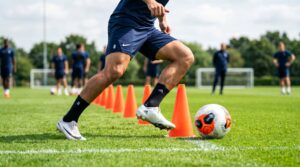
What it trains: Close dribbling control, foot coordination
Set up 5–6 cones in a straight line, about one meter apart. Dribble through them using the inside and outside of the same foot alternately. Focus on keeping the ball within touching distance at all times—not kicking it forward and chasing it.
Start slowly and build speed only once your touches feel clean. This is one of the most effective beginner football drills because it mimics the quick changes of direction required in a real match.
Key tip: Keep your knees slightly bent and your body low over the ball.
2. Juggling The Ultimate Ball Mastery Drill

What it trains: Touch sensitivity, coordination, concentration
Juggling is the classic way to learn how to control balls, and for good reason. It takes real skill to keep the ball up for ten touches in a row.
If you need to, start with one bounce between each touch. Start by juggling with both feet, then add your thighs and head. Don’t worry about getting a lot of points at first; just make sure you hit the ball cleanly and with control every time.
Progression: Try juggling while moving forward or in a small circle to make it more game-relevant.
3. Wall Passing Improve First Touch Football

What it trains: First touch, passing accuracy, receiving under pressure
Look for a flat wall and kick the ball hard against it. When it comes back, touch it once to control it, and then pass it back. Change the speed and angle to make it feel like you’re getting different kinds of passes in a game.
This drill is great for improving your first touch in football because the ball comes back at different speeds and angles, just like in a real game. Try to catch the ball with the inside of your foot, the outside, your chest, and your thigh.
Challenge version: Control the ball and return it in one fluid motion without pausing.
4. The Sole Roll

What it trains: Ball mastery, spatial awareness, balance
Put your foot on top of the ball and move it back and forth with the bottom of your foot. Begin with one foot and then switch. This simple move is taught in professional academies all over the world because it helps players feel connected to the ball.
Once you’re used to it, try rolling the ball back and forth and then switching feet in the middle of the roll.
5. Figure of 8 Dribbling

What it trains: Tight dribbling, quick footwork, balance
Place two cones about two meters apart. Dribble the ball in a figure-of-8 pattern around them, using both feet. This is one of the best soccer ball control exercises for improving your weaker foot because the pattern forces you to use both sides equally.
Coaching point: Don’t look at the ball once you’re comfortable — train yourself to keep your head up.
6. The Box Drill
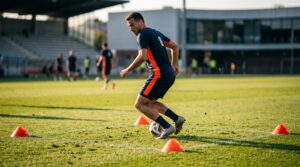
What it trains: Dribbling control, turns, directional change
Set up four cones in a square, roughly four meters per side. Dribble to each cone and perform a different turn inside cut, outside cut, Cruyff turn, or stop-and-go. Move around the full box and repeat.
This is one of the most valuable football training drills for players who want to improve their ability to change direction under pressure. It simulates tight spaces you’ll encounter in a real game near the touchline, in midfield battles, or in the penalty area.
7. Rondo (With a Group)

What it trains: Ball control under pressure, quick thinking, passing
If you have a small group, a rondo is arguably the best soccer skills training exercise in existence. A small number of defenders stand in the middle while the players on the outside try to keep possession.
The constant pressure forces you to control the ball quickly, think fast, and move it before defenders close you down. It’s used at every top club in the world, from Barcelona’s La Masia to Premier League academies, because it translates directly to match conditions.
Minimum players needed: 4 (three outside, one inside).
8. The Maradona Turn

What it trains: Advanced ball mastery, creativity, and turning under pressure
Named after Diego Maradona, this move combines a drag-back with a 180-degree spin. As a defender approaches, use the sole of one foot to roll the ball backward, step around it with the other foot, and accelerate away in the new direction.
It sounds complex, but it breaks down into simple steps. Practice it slowly first—stop at each stage — then build it into one fluid movement. This move is a genuine match-winner and will noticeably improve your dribbling control.
9. Two-Touch Wall Drill

What it trains: Consistent first touch, quick decision-making
This drill is a natural progression from the basic wall-passing drill. The rule: you have exactly two touches — one to control, one to pass back. There’s no extra touch allowed.
This constraint requires your first touch to be efficient and purposeful, rather than simply stopping the ball dead. Over time, your receiving technique will become much sharper because every touch has a consequence.
10. Free Dribbling in a Grid
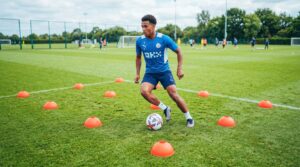
What it trains: Creative ball control, spatial awareness, improvisation
Mark out a grid roughly 10 x 10 metres (use cones or jumpers). Dribble freely within that space, practising any moves you’ve been working on. If alone, try to use both feet equally. If with others, add light pressure from a partner.
This drill is less structured than the others — intentionally. Football isn’t a set of choreographed movements. You need to improvise, adapt, and feel comfortable with the ball in unpredictable situations. Free dribbling sessions build that comfort.
How to Structure Your Ball Control Training Sessions
Knowing the drills is only half the battle. How you organize your training is equally important.
Here’s a simple weekly structure that works well for beginner to intermediate players:
Session 1 – Foundation (20–25 minutes) Start with juggling (5 min), then move to the sole roll and inside-outside cone dribble. Finish with wall passing.
Session 2 – Dribbling Focus (25–30 minutes) Warm up with juggling. Work through the figure of 8, box drill, and free dribbling grid. Try the Maradona turn at the end.
Session 3 – Pressure and Speed (20–25 minutes) Two-touch wall drill as the core exercise. Add a rondo if you have a group available. Increase speed throughout the session.
Rest for at least one day between sessions to let your muscles and motor patterns consolidate.
Common Mistakes That Hold Players Back
Even with good drills, certain habits can slow your progress. Watch out for these:
Always use your dominant foot. Most players naturally favour one foot. Forcing yourself to use your weaker foot—even if it feels clunky is essential for becoming a complete player.
Standing too upright. Ball control requires a low center of gravity. Bent knees, weight on the balls of your feet, and a slight forward lean all aid in your quick reactions.
Looking down constantly. Elite players control the ball by feel, not by watching it. Start training your eyes to be up as early as possible.
Practicing at speed before mastering technique. Speed comes last. Get the movement right at a slow pace first, then gradually increase.
Skipping sessions. Ball control is a motor skill. It’s built through repetition over time not through one intense session per week.
FAQ: Improve Ball Control in Football
How long does it take to improve ball control in football?
Most players notice meaningful improvement within 4–6 weeks of consistent daily or every-other-day practice. The keyword is consistent. Doing 15–20 minutes of focused ball mastery drills most days will produce faster results than longer but infrequent sessions. Some players see noticeable change even sooner if they’re beginners, because early gains come quickly.
Can I improve ball control by myself?
Absolutely. The majority of the drills in this guide are designed for solo practice. Wall passing, juggling, cone dribbling, and ball mastery exercises all work perfectly without a training partner. In fact, solo sessions can be more focused because there are no distractions — just you and the ball.
What is the best drill to improve your first touch in football?
Coaches consistently cite the wall-passing drill as the single best exercise for improving first touch. It’s endlessly repeatable, requires no partner, and exposes you to a constant variety of ball speeds and angles. The two-touch variation makes it even more effective.
Are these drills suitable for beginners?
Yes. All 10 drills in this guide are beginner-friendly and scale with your ability. Start with simple versions of each slow pace, short distances and increase difficulty as your control improves. Even professional players regularly return to basic ball mastery drills as part of their warm-up routines.
How do I improve dribbling control specifically?
Combine the cone drills (inside-outside and figure of 8) with free dribbling grid sessions. The cone drills build technical precision, while the free grid encourages creative expression and improvisation. Add the Maradona turn and box drill once the basics are solid. Dribbling control improves fastest when you practice in conditions that simulate match pressure, tight spaces, quick direction changes, and time constraints.
Conclusion: Start Small, Stay Consistent, Trust the Process
Ball control isn’t a talent you’re born with; it’s a skill you build, one session at a time. The 10 football ball-control drills in this guide cover everything from basic first-touch exercises to advanced ball-mastery moves. Work through them progressively, focus on quality over quantity, and be patient with yourself.
The players you admire for their smooth control got there through thousands of hours of exactly this kind of deliberate practice. Nothing is stopping you from doing the same.
Ready to take your training further? Pick three drills from this list and commit to practicing them every day for the next two weeks. Track your progress; you’ll be amazed at how quickly things improve.
This article was written to help players at all levels understand and apply the fundamentals of football control training. Whether you’re looking to sharpen your first touch, master the ball at pace, or simply enjoy the game more consistent practice with the right drills makes all the difference.
